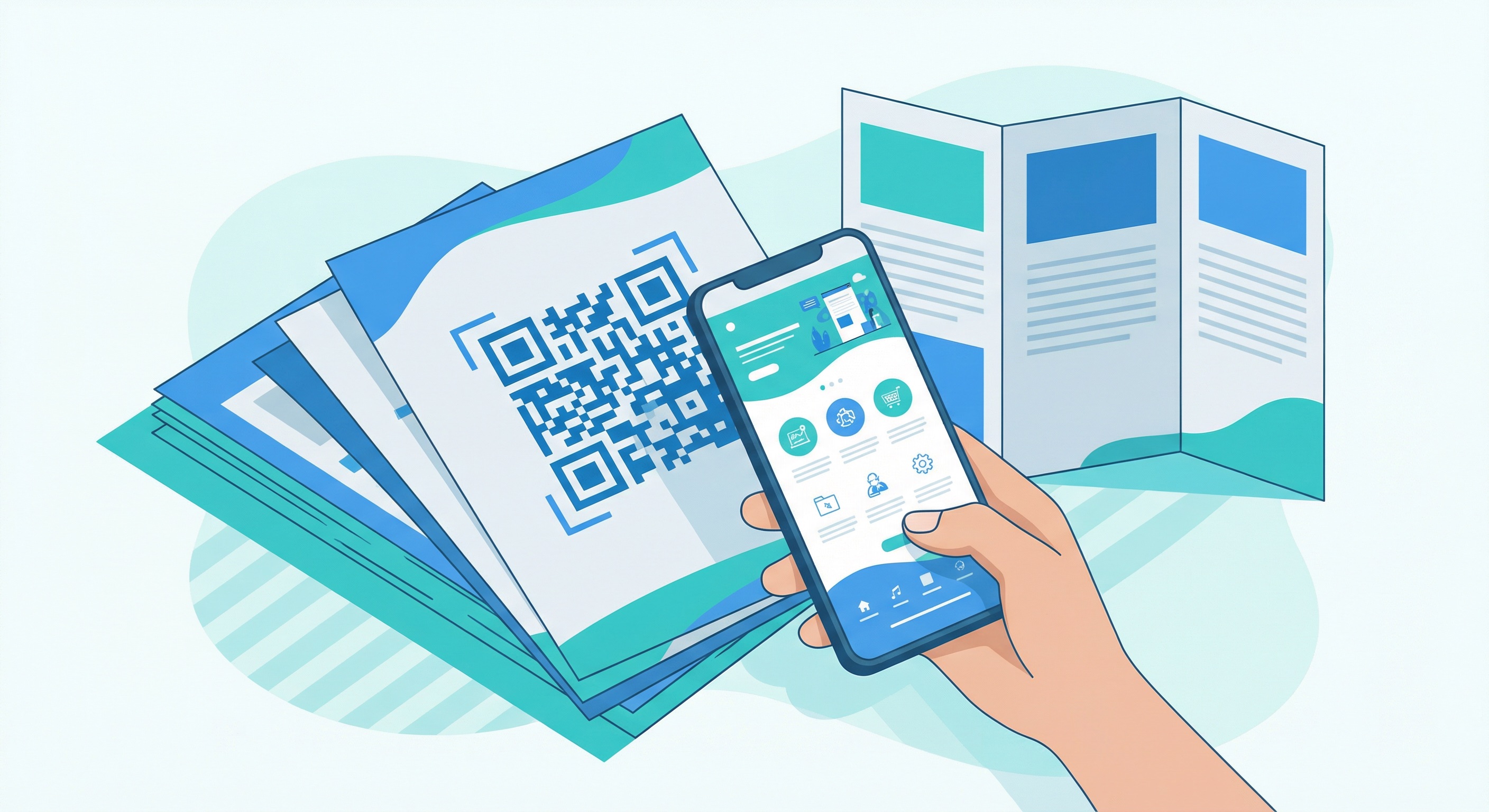

Print marketing is not dead — it is measurable for the first time. Direct mail delivers a 161% ROI, making it the highest-performing marketing channel in 2025, and 84% of consumers read flyers and direct mail immediately or on the same day (Lob State of Direct Mail 2025). Adding a QR code to a flyer or brochure transforms a one-way print piece into a two-way conversation — tracking who engaged, when, and what they did next.
QR code usage grew 323% between 2021 and 2024, and 5.3 billion QR code coupons are now redeemed annually — many of them from printed flyers and brochures. This guide covers everything you need to know about using QR codes on flyers and brochures: the key benefits, real-world applications by industry, the latest statistics, and a step-by-step guide to getting started with Supercode.
The biggest limitation of traditional print marketing has always been measurement. With a QR code, every flyer becomes a trackable conversion channel. Scan analytics from Supercode's dashboard tell you how many people scanned, on what device, in which location, and at what time — data that a printed flyer alone can never provide. When combined with UTM parameters on your destination URL, scan data flows directly into your website analytics, letting you attribute revenue and conversions back to specific print campaigns. See the complete QR code tracking guide →
A flyer or brochure has finite space. A QR code is unlimited. Use a code to direct readers to a full product catalogue, a pricing table, a video demonstration, a registration form, or a detailed service guide — everything that would not fit in print. For healthcare organisations, a flyer QR code can link to a full treatment guide, appointment booking, or patient portal. For educational institutions, it can link to a course prospectus, virtual campus tour, or application form. Print creates the first impression — QR codes complete the journey.
With a dynamic QR code, the printed code stays the same while the destination can change at any time. A conference brochure printed months in advance can have its QR code redirected to the live schedule once it is published. A promotional flyer can be redirected from a pre-launch page to an active sales page on launch day. A seasonal offer flyer can redirect to updated deals without a new print run. This flexibility eliminates one of the most costly aspects of print marketing — the reprint. Businesses using dynamic QR codes report 60% higher engagement rates than static codes, with significant annual savings from avoided reprints.
A flyer QR code that links to a lead capture form — a free consultation booking, a resource download, a trial sign-up — turns a distributed print piece into a lead generation machine. Trade show and conference brochures are especially effective as lead capture tools: a QR code linking to a contact form or vCard QR code means every brochure pickup can become a qualified contact. Explore the full strategy in the QR code lead generation guide.
Print multiple flyer variants targeting different audience segments, each with a unique dynamic QR code pointing to a segment-specific landing page. Bulk QR codes make it easy to generate hundreds of unique codes at scale — enabling personalised campaigns across geographic regions, customer personas, or product categories. 88% of marketers report personalised mail improves response rates (Lob 2025), and personalised QR destinations amplify that effect.
A QR code on a flyer or brochure can replace an entire package of additional printed materials: price lists, specification sheets, FAQs, and instructional guides. This reduces paper consumption, printing costs, and the weight of mailing packs. For brands with environmental commitments, linking to a digital brochure, a sustainability report, or a responsible sourcing page from a QR code on a compact flyer tells a powerful story. See how QR codes support sustainable marketing and how eco-aware consumers respond to QR-enabled transparency.

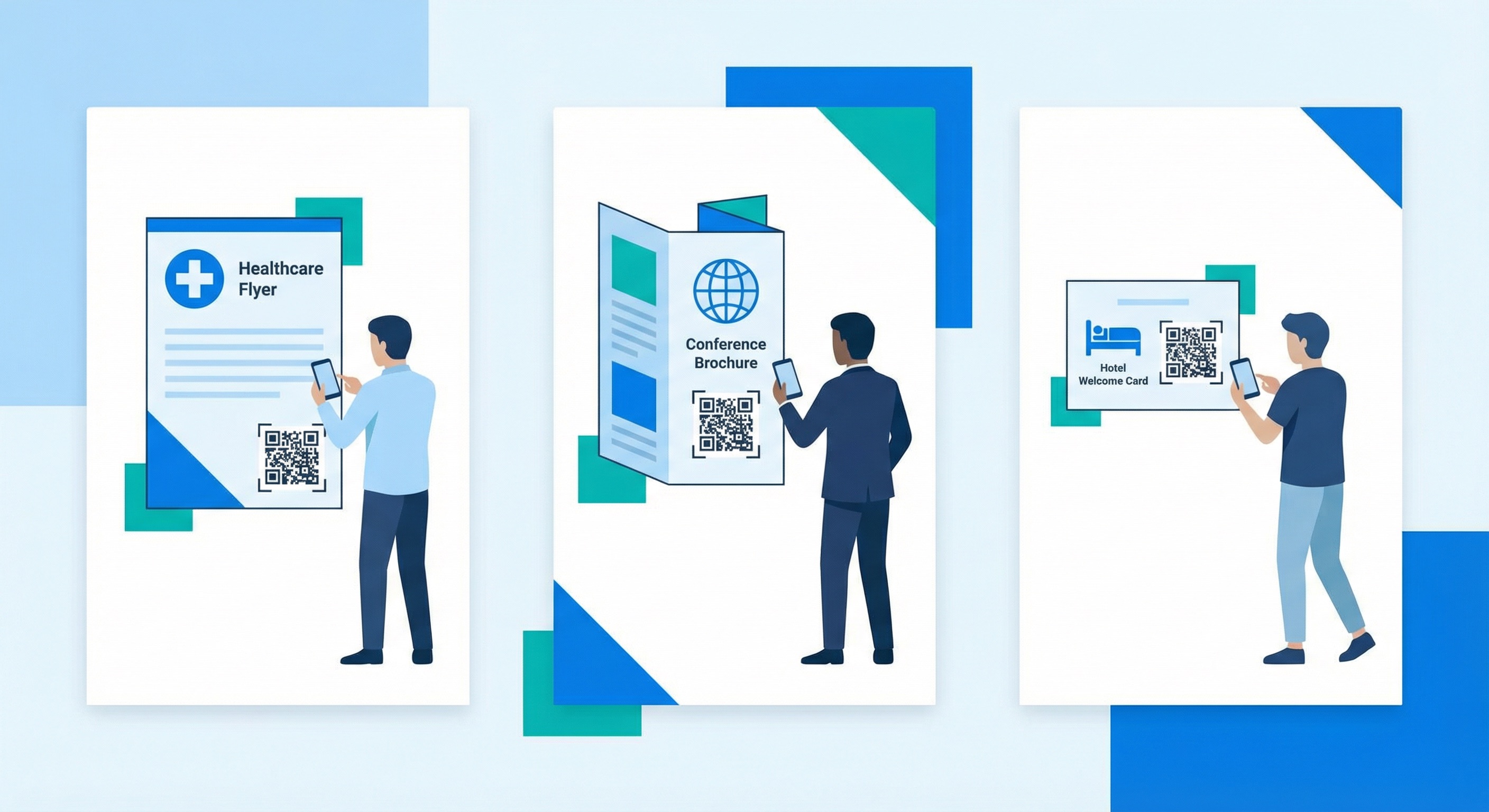
From conference programmes to festival programmes, a QR code turns a printed schedule into a live digital experience. Event organisers use brochure QR codes to link attendees to session registration, live schedule updates, speaker profiles, and venue maps — all from a single scan. Dynamic codes are ideal here: session schedules and locations often change before and during events, and a dynamic code lets organisers redirect to the latest version without invalidating the printed brochure.
Healthcare providers use flyers and waiting room brochures to distribute patient information, appointment reminders, and health campaign materials. A QR code on a health campaign flyer can link to a symptom checker, an appointment booking portal, a multilingual FAQ, or a prescription information page. This is particularly effective for public health campaigns where reaching diverse audiences with accessible, language-specific content is critical. Use a PDF QR code for detailed clinical guides that patients can download and read at home.
Trade show exhibitors and B2B sales teams use brochures to introduce their products and services — but the most valuable action is capturing a contact. A QR code on a sales brochure linking to a demo request form, a vCard QR code for instant contact exchange, or a product video can dramatically increase lead conversion from distributed print. For multi-product catalogues, link different QR codes on different pages to specific product pages, pricing sheets, or case studies — giving the reader an immediate, relevant digital experience at each stage of the brochure.
Hotels, resorts, and serviced apartments use in-room brochures and welcome packs to introduce guests to services. A QR code on a welcome card links to the digital menu, spa booking, local attraction guides, or a feedback form — all in one scan. This reduces printing costs (no need to update printed menus seasonally), speeds up service, and creates a premium digital touchpoint from a simple folded leaflet. Combine with a WhatsApp QR code to offer guests instant concierge messaging.
Schools, colleges, and universities distribute thousands of brochures and flyers at open days, career fairs, and through postal campaigns. A QR code on a prospectus can link to a virtual campus tour, an application form, a course finder, or an accommodation video — content that would be impossible to include in a printed document. Dynamic codes let admissions teams redirect traffic as campaign deadlines approach: pre-open day (video tour) → open day (registration form) → post-open day (application portal).
Financial services and insurance companies use branded brochures as trust-building tools. A QR code linking to a fee calculator, a KYC (Know Your Customer) onboarding portal, a regulatory compliance document, or a personalised quote generator makes a brochure far more actionable. Use email QR codes for enquiry routing or PDF QR codes for detailed product disclosure documents — ensuring clients always access the most current version of regulatory materials, even if brochures were printed months earlier.
A promotional flyer with a QR code is one of the most effective loyalty programme activation tools available. Link the code to a loyalty sign-up page, a points redemption portal, or an exclusive members-only offer. For retail brands, inserting a loyalty activation flyer into an order pack with a QR code linking to a "refer a friend" page or a repeat purchase discount converts a one-time buyer into a repeat customer. With feedback QR codes, a flyer inserted into a delivery box can also capture post-purchase satisfaction scores.
Print marketing combined with QR codes outperforms pure digital campaigns across multiple metrics.
For full QR code adoption data across all channels and industries, see the QR code statistics 2026 report.
Getting your flyer or brochure QR code right requires planning before the print file is finalised. Here is the full process with Supercode.
Never use static QR codes on printed flyers or brochures. Static codes cannot be updated, provide zero analytics, and cannot be redirected if the destination URL changes. Dynamic QR codes resolve through a short URL you control — meaning the printed code is a permanent asset that you can redirect, track, and optimise indefinitely. For multi-batch or seasonal print campaigns, this is not optional.
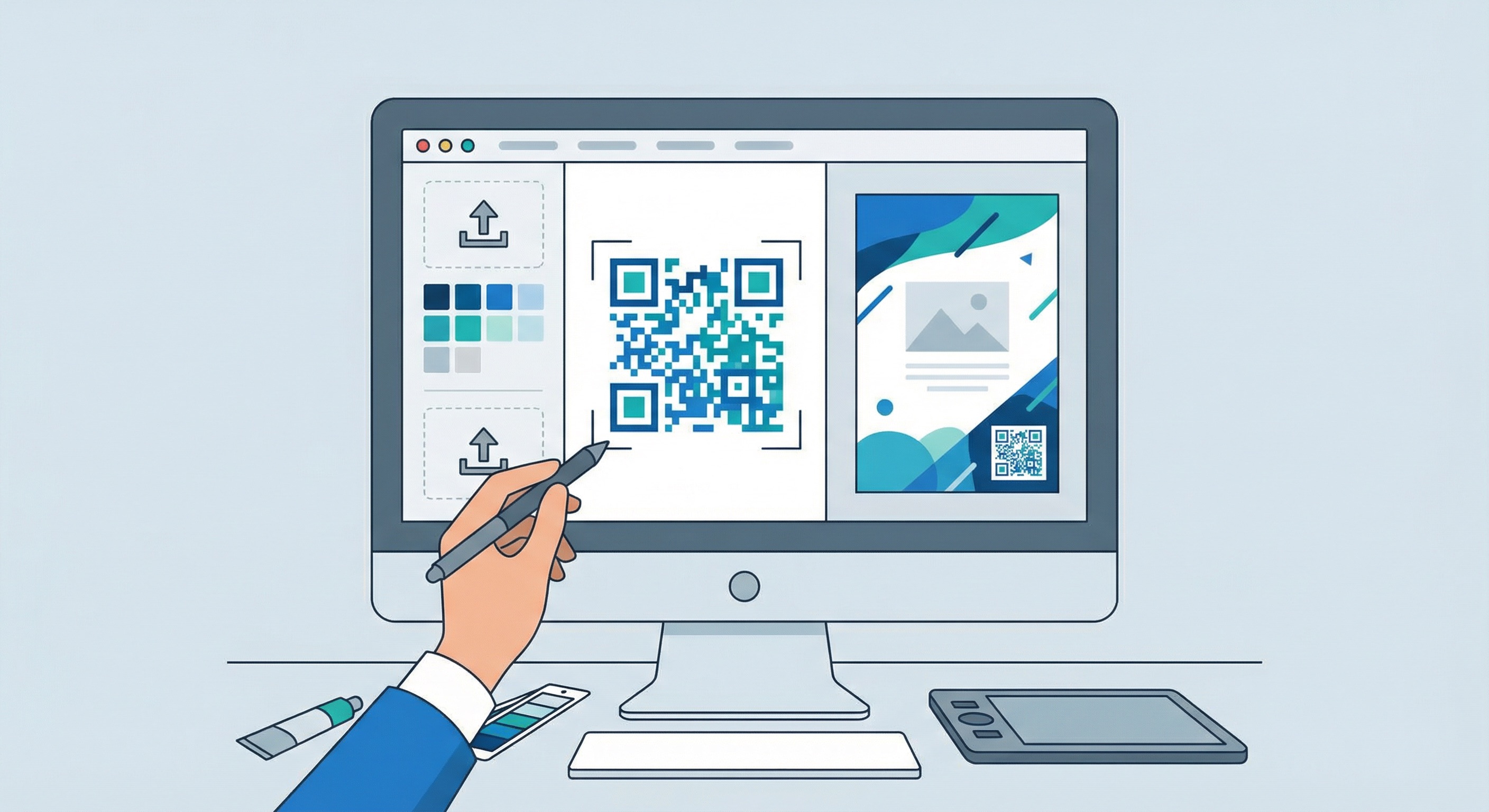
A QR code on a flyer should look intentional, not like an afterthought. Use Supercode's design tools to apply your brand colours and add your logo — custom-branded codes achieve 30–45% higher scan rates than plain black-and-white codes. Technical requirements for print:
See the complete QR code printing guide for format-by-format DPI and sizing specifications.
The CTA next to a flyer QR code is as important as the code itself. Research shows a strong vs. weak CTA can produce a 10-fold improvement in scan rates (Stannp, 2025). Keep it action-focused and benefit-led: "Scan to book your free demo", "Scan for your 20% discount", "Scan to download the full guide". Avoid generic CTAs like "Scan here" or "Visit us online" — these provide no motivation to act.
Use Supercode's folder system to organise QR codes by campaign, channel, and print batch. For agencies and brands running multiple simultaneous print campaigns, folder-level sharing lets different teams manage their own campaigns while maintaining centralised oversight. This prevents the common problem of lost or undocumented codes across large print portfolios.
Once flyers are distributed, check the Supercode analytics dashboard daily during the active campaign window. Monitor scan volume and time-of-day peaks (to understand when recipients engage), device types (to confirm your mobile landing page performance), and geographic distribution (to evaluate which distribution areas are most responsive). If engagement is low, use the dynamic code's redirect feature to test a different landing page — no reprint required. Full guidance in the QR code tracking guide.
Always print and scan a proof before approving the full print run. Test under typical lighting conditions (including fluorescent office light and lower-light settings), at the intended scan distance, and on both iOS and Android devices. A code that scans perfectly on screen may fail on certain paper finishes — particularly high-gloss laminated stock or metallic foil papers. The 10 QR code mistakes to avoid has a complete pre-print testing checklist.
A brochure with four different QR codes pointing to four different destinations creates confusion and dilutes engagement. Best practice is one primary QR code per flyer, with a single clear action. If you need multiple destinations, use a single URL QR code linking to a hub landing page that then presents the reader's next options — this preserves clarity while enabling multiple downstream actions. For multi-page brochures, placing a relevant code at the end of each product section is effective, provided each code has its own clear CTA.
Every flyer scan happens on a smartphone. If the destination page is not mobile-first, you will lose the conversion even after winning the scan. Use dynamic codes to swap a non-performing landing page for a better one without reprinting. Run Google's Mobile-Friendly Test on your destination URL before print approval. Check load time (target under 3 seconds on mobile), tap target sizes, and form field usability on small screens.
QR code scan data is most valuable when it connects to your full marketing analytics stack. Add UTM parameters to every QR code destination URL — utm_source=flyer, utm_medium=print, utm_campaign=campaign-name — so scan-to-conversion journeys are trackable in Google Analytics 4 or your CRM. For lead-gen campaigns, integrate your QR landing page form with your marketing automation platform so new leads enter the right nurture sequence automatically. The tracking guide covers GA4 integration step by step.
One of the most common flyer QR code failures is a mismatch between print and digital readiness. Flyers are often distributed before the destination page is live. Always confirm the QR code destination is live, tested, and mobile-optimised before approving the print run. For campaigns with staged launches, use dynamic codes with a pre-scheduled redirect plan — and set calendar reminders to activate each stage on time.
The QR code should be prominent but not dominant. On a standard A5 flyer, the code should occupy roughly 15–20% of the total area and be positioned after the primary message has been delivered — typically in the lower third. Surround it with enough white space that it reads cleanly against the print background. Use the QR code design guide for detailed layout recommendations by flyer format.
Yes — if you use a dynamic QR code. Dynamic codes redirect through a short URL you control, so you can update the destination at any time without changing the printed code. This is essential for print campaigns where the digital content evolves after printing. Static QR codes are permanently fixed and cannot be changed. See our dynamic vs. static QR code comparison for a full breakdown.
The minimum recommended size is 2cm × 2cm for scanning at arm's length (20–30cm). For A5 and A4 flyers, 2.5–4cm is more practical and provides better scanability in varied lighting conditions. Always include a quiet zone of 4 modules on all sides — cramping the code against text or image elements is one of the most common causes of scan failure. See the full sizing guide in the QR code printing guide.
Match the destination to the flyer's purpose and the CTA next to the code. Common destinations: booking forms (events, healthcare, hospitality), product pages with exclusive flyer-viewer discounts (retail), video introductions (professional services, education), digital brochures in PDF format (B2B, finance), and loyalty programme sign-up pages (FMCG, retail). The key rule: the scan experience should deliver the exact value promised by the CTA in a single tap, with no additional navigation required.
With a dynamic QR code from Supercode, every scan is automatically logged in the analytics dashboard — capturing scan volume, device type, location, and time. For campaign attribution, add UTM parameters to the destination URL so scan data flows into your website analytics alongside other channels. For multi-batch or multi-zone campaigns, use unique codes per batch (via bulk QR codes) to compare performance across distribution areas. Full instructions in the QR code tracking guide.
No — the same URL QR code or PDF QR code works across all print formats. What matters for brochures is using a dynamic code (for updateability), exporting at sufficient resolution (SVG or 300+ DPI PNG), and maintaining adequate contrast and quiet zone. Brochures often use higher-quality paper stocks and finer print resolutions, which actually improves QR code scanability compared to lower-quality flyer paper.
The technical QR code is identical — the difference is strategic. A flyer is typically a single-page, high-volume, short-shelf-life piece, so the QR code destination should be a single focused action (book now, claim offer, register). A brochure is a multi-page, longer-shelf-life, higher-value piece, so QR codes within it can link to deeper content at each section — product videos, detailed spec sheets, customer testimonials — creating a richer digital extension of the printed experience. Both should use dynamic codes for flexibility and analytics.
Every flyer or brochure you print is an opportunity to capture leads, track engagement, and drive digital conversions. With Supercode, you can create dynamic QR codes in seconds, design them to match your brand, generate hundreds of unique codes in bulk, and monitor real-time campaign performance — all from one dashboard. Pair your print campaigns with the power of QR code analytics and make every distribution count in 2026.
Head to our FAQs section or reach out to us directly on info@supercode.com
Sign up for free

