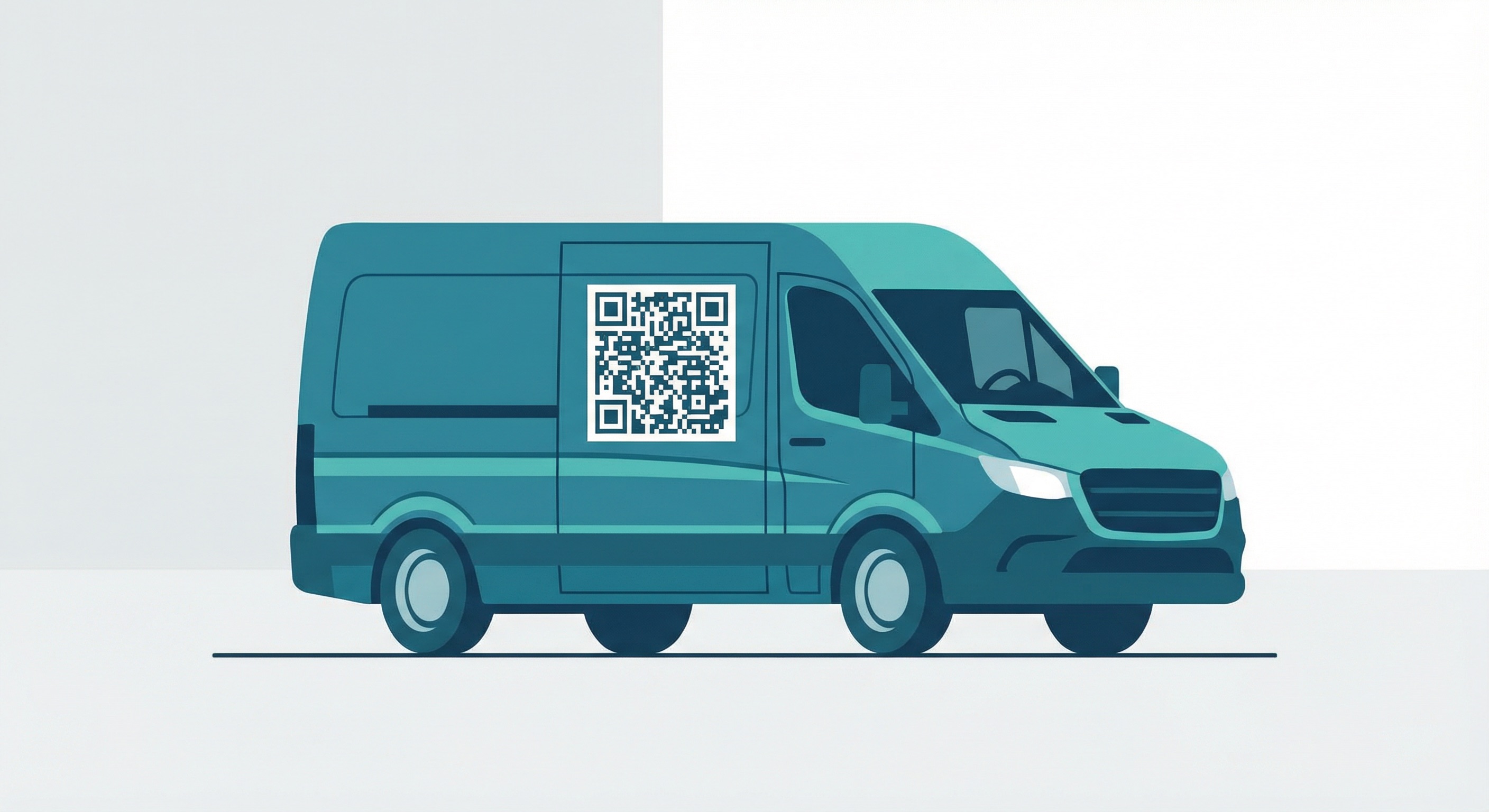

QR codes on vehicles turn your fleet into a measurable, interactive marketing channel. With 94 million U.S. consumers expected to scan QR codes in 2025 — rising to 102.6 million by 2026 — placing a dynamic QR code on your company vehicle means every mile your team drives delivers real business value. A single wrapped intercity vehicle can attract up to 12 million views per year, making fleet QR codes one of the most cost-efficient advertising placements available to any business.
Whether you operate a catering van, a logistics fleet, a food truck, or a real estate company car, QR codes on vehicles transform passive brand presence into active customer engagement. This guide covers the key benefits, real-world applications, creation steps, and best practices for deploying QR codes on vehicles in 2026 — including how to track every scan with Supercode's real-time analytics.
Unlike static billboards that wait for audiences to come to them, a vehicle QR code travels with your brand. According to a 2025 OAAA/Nielsen study, 64% of U.S. residents noticed a wrapped vehicle in the previous month and 44% noticed one weekly. With an average cost per thousand impressions (CPM) of just $0.48 — compared to $3.56 for billboards — fleet advertising with QR codes delivers extraordinary reach at a fraction of the cost of traditional media. Vehicle wraps also achieve 97% message recall versus just 19% for stationary ads.
One of the greatest advantages of using dynamic QR codes on vehicles is flexibility. With a dynamic code, you can update the destination URL, campaign content, or promotional offer instantly from your Supercode dashboard — without touching the physical code on the vehicle. Running a seasonal promotion? Update the landing page. Launching a new service? Change the destination in seconds. This makes dynamic codes far more cost-effective for fleet campaigns than static alternatives.
QR codes on vehicles reach two audiences at once: people you already do business with directly — such as B2B clients, trade partners, and logistics contacts encountered at loading bays — and members of the public who encounter your vehicle in parking lots, at events, or on city streets and may become new customers. A freight forwarding company's truck at a loading dock directly advertises to logistics professionals who need the same service. A catering van at a corporate event markets to attendees who may book for their own event.
Instead of displaying only a phone number, a QR code on a vehicle provides immediate access to your full digital presence — product galleries, video content, digital menus, contact forms, social media profiles, and more. With a Image QR code, you can showcase a visual portfolio. With a WhatsApp QR code, customers can message you directly in a single tap. Social Media QR codes grow your following from every parking spot.
Unlike traditional vehicle wraps, QR codes produce hard performance data. Using Supercode's QR code tracking, you can measure scan volume by location, time of day, and device type for every vehicle in your fleet. Create unique codes per vehicle using bulk QR code generation and compare performance across routes, cities, or driver assignments. This transforms your fleet from a cost centre into a measurable marketing asset.
Beyond marketing, QR codes on vehicles serve critical safety and trust-building functions. Mercedes-Benz pioneered the rescue sticker QR code — affixed inside the fuel filler flap — allowing emergency services to instantly access the correct rescue card for the specific vehicle model in the event of an accident. For taxi, ride-share, and private hire operators, QR codes containing driver identification information add a verifiable safety layer that builds passenger confidence before and during a journey.

From delivery vans to service cars, branded vehicles with QR codes turn your existing fleet into a rolling marketing channel. Place a URL QR code linking to your homepage, product page, or booking form on every company vehicle. This is particularly powerful for local businesses competing with national operators — a local HVAC firm that parks its van at a farmers' market reaches exactly the homeowners who need its services, and the QR code converts curiosity into qualified leads.
Placing QR codes on freight trucks and heavy transport vehicles builds industry-specific brand recognition at precisely the right moment. When trucks load and unload, they are stationary for extended periods — giving logistics managers, warehouse operators, and procurement teams time to scan and learn more about the service. This B2B targeting is both intentional and highly qualified: the people scanning are exactly those who need freight, haulage, or supply chain services. The public transport and logistics industry is one of the fastest-growing sectors for QR code adoption.
Food trucks at outdoor markets, corporate campuses, and community events benefit enormously from vehicle QR codes. A prominent code on a food truck can link to your full menu, allow customers to pre-order via app, book the truck for private events, or follow your social media. For food truck operators, a QR code transforms a single event appearance into ongoing customer relationships. Link to a restaurant-style digital ordering experience and watch your booking rate climb.
Real estate agents have long used vehicle advertising, but QR codes elevate this beyond a phone number. A code on a real estate car can link to a live property listings page, contact form, or virtual tour gallery. Since dynamic QR codes are editable, listed properties can be updated without touching the vehicle. This works particularly well in residential neighborhoods where potential buyers are already browsing streets — the vehicle becomes a hyperlocal property advertising platform.
Airport and hotel shuttles connect travelers with their destination — an ideal opportunity to promote dining, experiences, and direct booking via QR code. A hotel shuttle QR code can link to a guest loyalty program, local attraction guide, or restaurant menu. For leisure and tourism operators, shuttle QR codes delivered to a captive, engaged audience are one of the highest-conversion vehicle placements available. Pair with city and tour guides to provide real value to travelers.
Department stores, retailers, and event organizers with delivery fleets can use QR codes on vehicles to promote seasonal campaigns — Black Friday, Christmas, back-to-school, or summer sales. Dynamic QR codes allow the campaign destination to be updated for every season without modifying the physical wrap. For large retail fleets, use bulk QR code generation to create unique, individually trackable codes for each vehicle so you can measure campaign performance per route and location. See how retail businesses deploy QR codes to drive in-store and online sales.
Pizza delivery drivers, meal kit services, and catering companies can place QR codes on their vehicles linking directly to their ordering page or app. When a customer's neighbor sees a delivery arrive and scans the code, they can immediately order their own. This word-of-mouth amplification turns existing customer deliveries into new customer acquisition events. Use an SMS QR code for areas with limited connectivity, allowing customers to text directly to book without needing an internet connection.

The data confirms that combining vehicle advertising with QR codes delivers exceptional results for businesses of all sizes:
Creating QR codes for your vehicle fleet with Supercode is fast, flexible, and measurable. Here's how to get started:
The best QR code type depends on your business goal:
Customize your code with your brand colors and add your company logo using Supercode's design tools. A well-branded QR code achieves 25–40% higher scan rates than generic black-and-white codes. Follow the QR code design guide for color contrast ratios, logo sizing limits, and quiet zone best practices that ensure your code remains scannable in all lighting conditions.
Download your QR code at a high resolution (SVG or PNG at 300 DPI minimum) for large-format printing. For vehicle exteriors where scanning happens at arm's length from a parked car, a minimum size of 5 cm × 5 cm is suitable. For larger fleet vehicles — trucks, vans, and buses — aim for 10–15 cm × 10–15 cm. Our QR code printing guide covers everything from resolution and file formats to material and laminate recommendations for outdoor use.
Print your QR code on durable, weather-resistant vinyl with a UV-protective laminate and apply it to your vehicle wrap design or as a standalone sticker. Place codes on rear doors, side panels, or tailgates at approximately 1 metre above the ground — the optimal eye-line height for a standing scanner. Avoid placement on moving parts, frequently dirty surfaces, or areas that are only visible to vehicles in motion.
Once deployed, monitor your vehicle QR campaigns using Supercode's analytics dashboard. Track scan volume, scanning location, device type, and campaign performance per vehicle. Dynamic codes allow you to update the destination URL for new promotions, A/B test landing pages, and instantly deactivate outdated campaigns — all without reprinting. View Supercode plans to find the right tier for your fleet size.
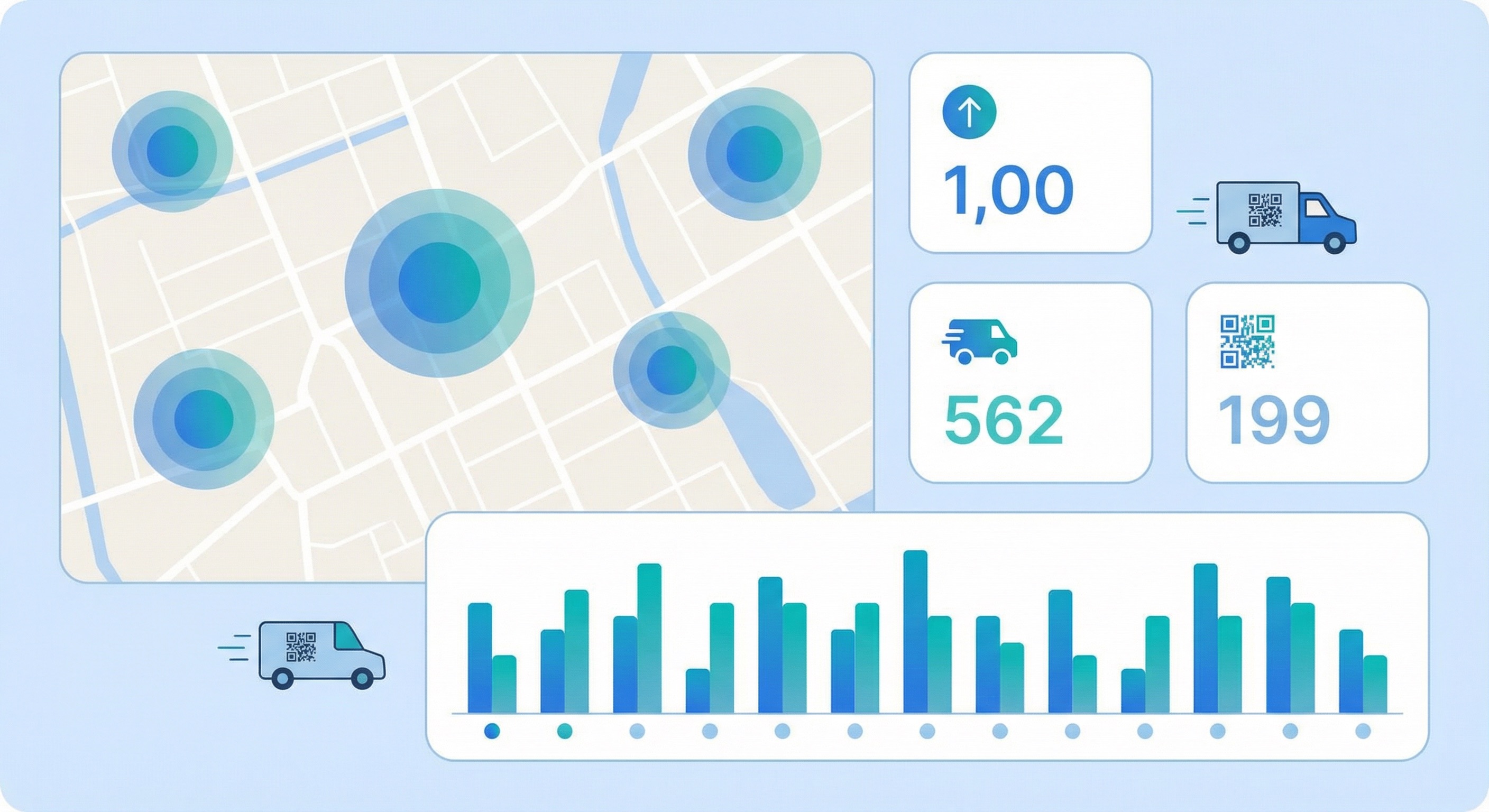
Dynamic codes give you the ability to update destination URLs, redirect to seasonal offers, and measure scan performance without reprinting anything. For a fleet that operates over months or years, this flexibility is invaluable. A static code linking to a discontinued promotion is a wasted opportunity every time your vehicle is seen. Understand the full difference in our dynamic vs static QR codes guide.
Size determines scannability. For parked vehicles scanned at close range, 5 cm × 5 cm is the practical minimum. For large trucks and delivery vans scanned from greater distances, use 10–15 cm × 10–15 cm. Always include a clear quiet zone of at least 4 modules around the code. Position codes on the rear and side panels of stationary vehicles — never rely on moving vehicles being scanned safely.
A QR code that blends with your vehicle design is more likely to be noticed and scanned. Use Supercode's design tools to match your brand palette and embed your logo. Ensure the code's foreground color has a high contrast ratio against its background — dark code on light background, never reversed. This also strengthens brand recall: even those who don't scan immediately associate your brand with the experience. See our custom QR code design guide for detailed color guidelines.
A QR code without a call to action (CTA) misses a critical engagement trigger. Include three to five words near the code — "Scan to order now", "Get a free quote", "See our menu" — to tell the viewer exactly what they will receive when they scan. Keep the CTA large enough to read at a glance from a few metres, and make it action-oriented.
Reinforce your vehicle QR campaign by using the same code on posters, business cards, and product packaging. Dynamic QR codes let you track which channel drives the most scans so you can allocate marketing budget more effectively. For home services businesses — plumbers, electricians, HVAC contractors — linking vehicle, flyer, and packaging QR codes to the same destination is particularly effective. See how home repair businesses use QR codes across channels.
Outdoor vehicle QR codes experience weathering, cleaning chemical exposure, and physical wear. Schedule quarterly inspections to confirm codes are undamaged and fully scannable. With dynamic codes through Supercode, even if a physical code becomes partially damaged, you can redirect the destination to a new URL immediately — protecting campaign continuity. Use QR code analytics to detect sudden drops in scan volume that may indicate a damaged code on a specific vehicle.
The minimum recommended size for a QR code on a vehicle is 5 cm × 5 cm for scanning at arm's length from a parked car. For larger fleet vehicles — vans, trucks, and buses — where scanning happens from a greater distance, use 10–15 cm × 10–15 cm. Always maintain a quiet zone (white border) of at least 4 modules around the code. Consult Supercode's QR code printing guide for full size recommendations by scanning distance and vehicle type.
Scanning a QR code on a moving vehicle is not practical or safe. Vehicle QR codes are designed for stationary scanning — when the vehicle is parked, loading, or stopped. Place codes on rear panels, side doors, and tailgates where they are accessible and readable when the vehicle is not in motion. This is where most productive scanning interactions occur: in parking lots, at loading bays, and at event venues.
Dynamic URL QR codes are the best choice for most vehicle applications because they are editable without reprinting. For trade and professional services vehicles, vCard QR codes enable direct contact sharing. For food trucks and catering vans, URL or Image QR codes linking to menus work best. For businesses in areas with limited connectivity, SMS QR codes allow customers to text to book without needing mobile data.
Yes. QR codes placed on vehicle exteriors should be printed on weather-resistant vinyl with a UV-protective laminate to prevent fading, cracking, and delamination. For interior applications — such as safety stickers, passenger information panels, or driver identification — standard vinyl labels are sufficient. Always test a printed code by scanning it across multiple devices before full fleet deployment.
Create a unique dynamic QR code for each vehicle using Supercode's bulk QR code generator, then organise them into a fleet campaign folder in your dashboard. Each code tracks scans independently, giving you per-vehicle performance data — including scan volume, device type, and geographic location. This makes it straightforward to compare which vehicle routes or parking locations drive the most engagement and adjust your fleet deployment accordingly.
The best destination depends on your business goal. Link to a website or landing page for brand awareness and lead generation, an ordering page or menu for food and catering businesses, a property listings page for real estate, a booking or quote form for service trades, or a Social Media QR code to grow your following. Dynamic codes allow you to test and switch destinations without reprinting — use Supercode's analytics to identify which destination generates the most conversions from your fleet.
Every vehicle in your fleet is an untapped marketing asset. With dynamic QR codes from Supercode, you can transform company cars, delivery vans, food trucks, and freight vehicles into measurable marketing channels that generate real business results. Track every scan, update campaigns instantly, and connect your entire fleet to your digital presence — all from one dashboard. Whether you operate a single van or a national fleet, Supercode's QR code generator gives you the tools to measure, optimise, and scale your vehicle marketing in 2026.
Start your free Supercode account today and put your vehicles to work.
Head to our FAQs section or reach out to us directly on info@supercode.com
Sign up for free

