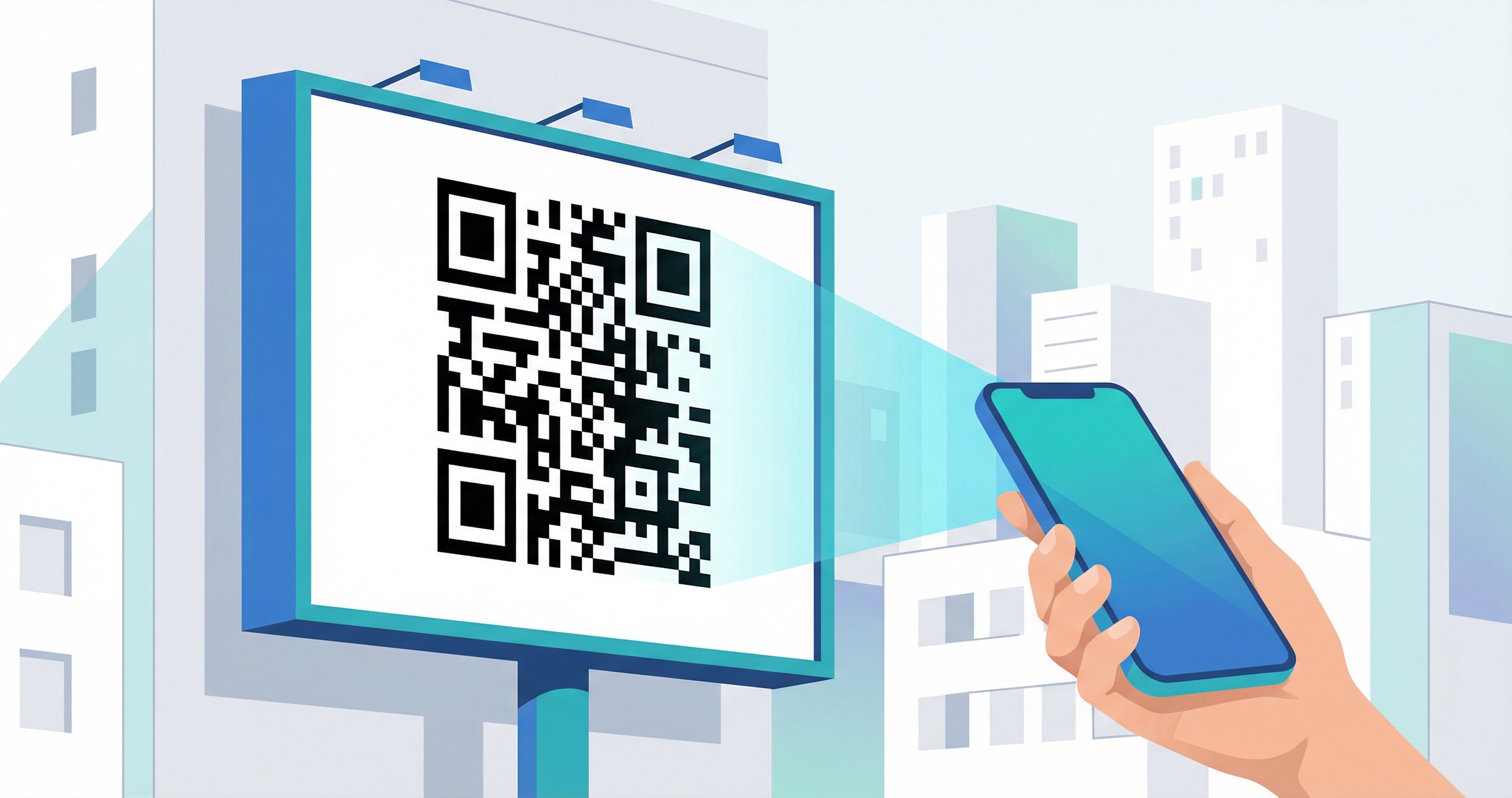

The global out-of-home (OOH) advertising market is on track to more than double in size — from $31.89 billion in 2023 to $66.93 billion by 2032, growing at a 9.72% compound annual growth rate. But for decades, billboard campaigns were impossible to measure: brands knew how many eyes could theoretically see a poster, but not how many people actually engaged. QR codes on billboards change everything. In 2026, a single dynamic QR code transforms any physical billboard, bus shelter, building hoarding, or street display into a fully trackable digital touchpoint — one that drives traffic, captures leads, and delivers analytics in real time.
With 93% of marketers now using QR codes and over 99.5 million U.S. consumers scanning monthly, outdoor advertising with embedded QR codes is the most cost-effective way to bridge physical presence with digital conversion. This guide covers the key benefits, applications, statistics, creation steps, and best practices for QR codes on billboards and street advertising — and shows how Supercode makes every outdoor placement measurable and editable, long after it goes live.
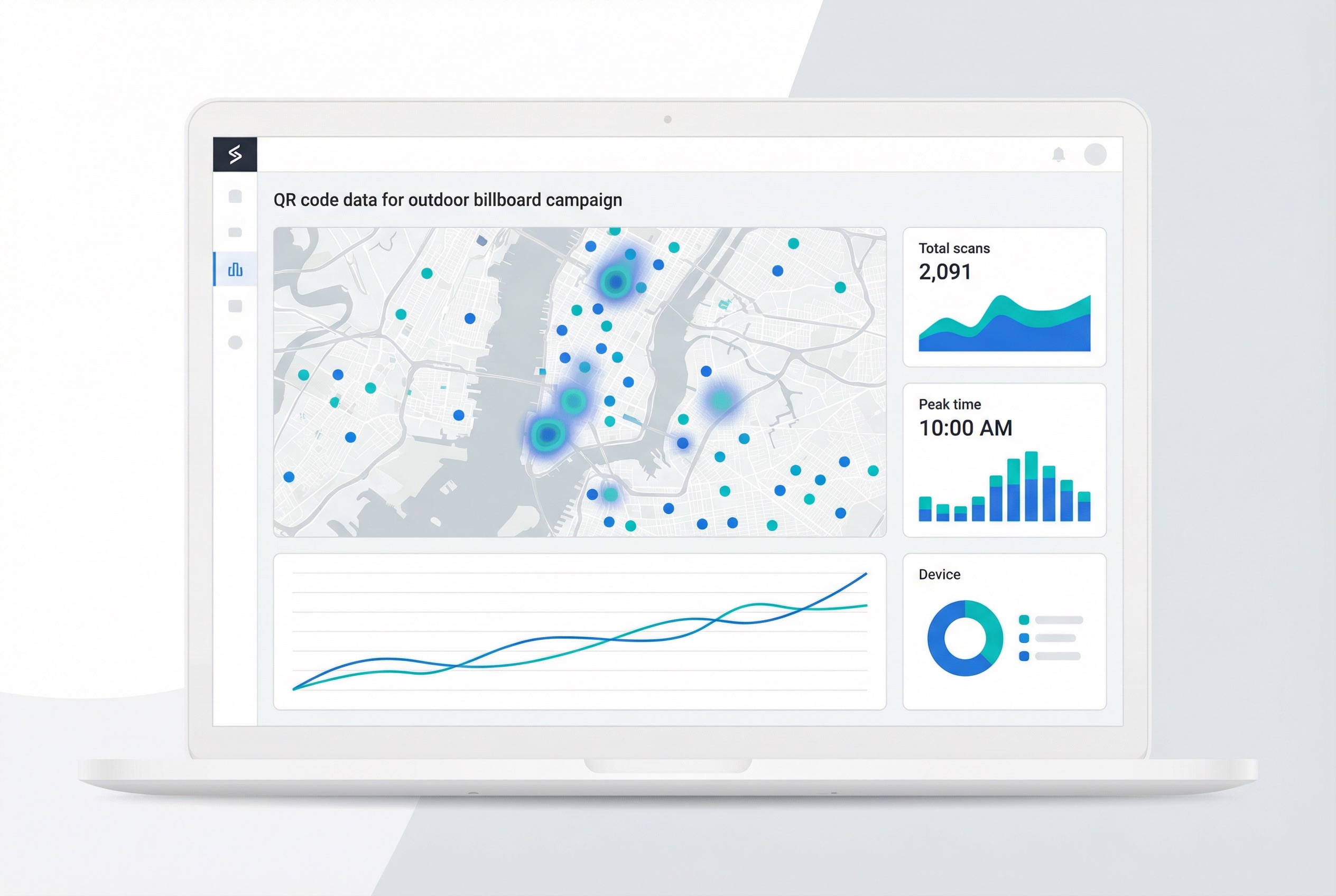
Traditional billboard campaigns measure estimated impressions — how many people might have driven past. A QR code changes this entirely. Every scan is a confirmed engagement: you capture the exact time, location, device type, and operating system of each interaction. Using Supercode's QR code tracking dashboard, you can view real-time scan data for every placement, plot scan density on a map, and understand which billboard locations deliver the strongest response. Combining OOH advertising with QR codes can boost ad awareness by up to 200% — and for the first time, you can prove it with data.
Billboards without QR codes are passive — they build awareness but cannot prompt immediate action. A QR code transforms a one-way display into a two-way interaction. A passerby waiting at a bus stop can scan and land on your product page, download your app, enter a competition, or follow your brand on social media within seconds. The most effective billboard QR codes pair a compelling offer with a URL QR code pointing to a dedicated mobile landing page — keeping the journey frictionless from scan to conversion.
Running a campaign across multiple sites — downtown, transit hubs, retail districts, event venues — is far more powerful when each placement carries a unique QR code. Use bulk QR code generation to create individual codes for each billboard, then monitor comparative performance in your Supercode dashboard. Which junction drives the most scans? Which time of day peaks? Location-specific QR analytics turn your outdoor media plan into a data-driven optimisation loop, letting you reallocate budget toward the placements that convert.
With a dynamic QR code, the code printed on the billboard never changes — but the destination behind it can be updated instantly from your dashboard. Launch a new product? Swap the landing page. Promotion expired? Redirect to a new offer. This is especially valuable for long-running outdoor campaigns: a single billboard with a dynamic QR code can cycle through different promotions, seasonal messaging, or event-specific content over its lifetime, without any reprinting cost or operational disruption.
When a passerby scans your billboard QR code and lands on your page, you can fire a tracking pixel to build retargeting audiences in Meta Ads, Google Ads, or your email platform. This turns a single OOH impression into a multi-touchpoint conversion funnel: someone sees your billboard, scans it, and then sees your ads across the web for days afterward. Pairing billboard QR codes with lead generation forms or competition entry pages captures first-party data that belongs entirely to your brand.
Billboards are one of the few advertising formats that cannot be blocked, skipped, or closed. A high-traffic billboard reaches everyone who passes — but without a QR code, none of that exposure is actionable. Adding a QR code layers individual engagement on top of mass reach: the billboard builds awareness at scale, while the QR code captures the fraction of viewers who are actively interested. These high-intent scanners are your warmest leads, and a well-crafted landing page converts them at a far higher rate than a cold digital ad impression. Pair your billboard campaign with QR codes on posters, displays, and brochures for a fully integrated OOH campaign.
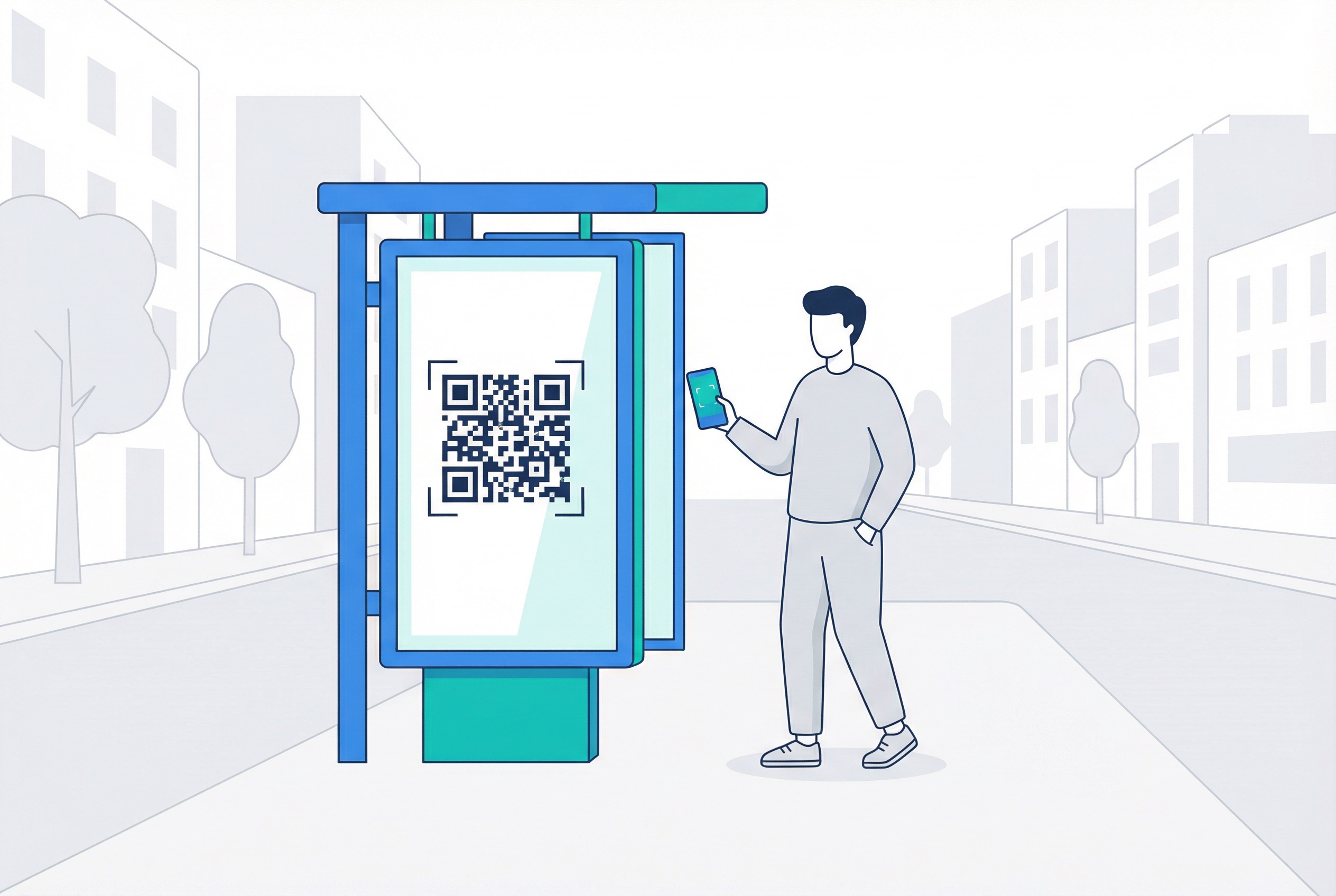
Retailers use billboard QR codes to shorten the path from awareness to purchase. A fashion brand advertising a new collection can point the QR code directly to the product page on its e-commerce site, allowing passersby to buy the item they just saw on the billboard before they reach the next junction. Calvin Klein ran this exact approach across billboards in Houston, Los Angeles, and New York — routing QR codes to video campaigns featuring new collections with measurable click-through results. QR codes in retail are growing at 43% year-over-year, and the billboard format extends that momentum into physical spaces. For shop windows and street-level retail displays, QR codes similarly bridge the gap between browsing and buying.
Event organisers and promoters use OOH QR codes to sell tickets, share schedules, and build anticipation. A billboard for an upcoming concert or festival can link to a ticket booking page, a trailer video, or an exclusive preview for early fans. BTS placed a QR code billboard in Japan to promote an album — the code linked to exclusive music previews and drove massive scan engagement from fans. QR codes for events work at every stage of the campaign: from pre-event awareness on billboards to on-site displays and follow-up flyers handed out nearby. For musicians and artists, billboard QR codes are a highly visible way to direct fans to streaming platforms, merch stores, or upcoming tour dates.
Cities, tourist boards, and transport authorities deploy QR codes on outdoor signage to deliver rich information experiences that a printed board simply cannot accommodate. A heritage trail marker can link to a multilingual audio guide. A city tourism billboard can route to an interactive map, hotel booking page, or AR experience of a historical site. QR codes for cities and tours and tourism campaigns benefit particularly from billboard placement in transport hubs and popular public spaces, where dwell time is naturally high and visitors are actively seeking information. Public transport environments — bus stops, train stations, metro platforms — are among the highest-performing locations for OOH QR code campaigns.
Convention centres, exhibition halls, and trade show venues are prime territory for outdoor QR code advertising. Businesses use billboards and hoardings near these venues to drive booth traffic, distribute digital brochures, and capture lead information from B2B buyers in the right mindset. A PDF QR code can deliver a product catalogue or technical specification sheet instantly to a prospect's device. QR codes for trade shows extend the reach of in-hall marketing to the streets and transport links around the venue, catching attendees before they even step inside.
Hotels and resorts use roadside billboards with QR codes to drive direct bookings, bypass OTA commissions, and entice travellers in the vicinity. A billboard near a motorway services can link to a room availability checker, a special rate landing page, or a video tour of the property. Little River Casino Resort used a QR code billboard on the side of a building to drive traffic to its website, offering incentives on restaurants, gaming, and room bookings — and measuring the resulting scan data. For hospitality brands, linking billboard QR codes to WhatsApp or live chat via a WhatsApp QR code allows potential guests to ask questions and receive booking assistance in real time.
Some of the most memorable OOH QR campaigns go beyond simple landing pages and deliver full augmented reality experiences. Nike used city-specific billboard QR codes to unlock AR try-on experiences for a new sneaker drop. Netflix teased a new series with billboards that showed only a QR code — scanning it revealed exclusive behind-the-scenes footage. The N Building in Tokyo's Tachikawa District is covered in a QR code that, when scanned, overlays real-time store information and downloadable coupons onto the building facade. By linking an Image QR code or a URL QR code to WebAR content, brands create share-worthy moments that extend the billboard's reach far beyond its physical location via social media.

The intersection of QR codes and outdoor advertising is one of the fastest-growing segments in performance marketing. Here are the key data points shaping the landscape in 2026:
Creating a print-ready QR code for your billboard campaign takes minutes with Supercode. Follow these seven steps:
The right QR code type depends on your campaign goal. For billboard advertising, the most effective options are:
Enter the URL of your campaign landing page, or configure the content for your chosen QR code type. For URL codes, always link to a mobile-optimised destination — the majority of outdoor QR scans happen on smartphones, so page load speed and mobile UX directly affect your conversion rate.
A customised QR code stands out on a billboard and significantly increases scan rates. Use Supercode's design tools to apply your brand colours, add a logo to the centre of the code, and select a frame with a short CTA ("Scan to Save", "Watch Now", "Get Offer"). For outdoor use, apply Level H error correction — this allows the code to remain scannable even if it sustains minor damage or weathering. Maintain a minimum 4:1 contrast ratio between the code and its background.
Organise your outdoor campaign by adding all related QR codes to a dedicated folder in your Supercode dashboard. You can share folders with your media buyer, print supplier, or wider marketing team, keeping all campaign assets in one place. Name each code by location for clear performance attribution.
Download your QR code in SVG or high-resolution PNG format for billboard print production. Consult the QR code printing guide for minimum size requirements at different viewing distances — a billboard QR code scanned from 3–5 metres should be a minimum of 10 cm × 10 cm, while a large-format roadside billboard may need the code sized at 50 cm × 50 cm or larger to allow scanning from further away.
Test the code by scanning it with multiple devices (iPhone and Android) at the intended viewing distance before sending to print. Verify that the destination loads quickly on mobile, displays correctly, and that the call-to-action matches what is written on the billboard creative. Use Supercode's QR code creation guide for a complete pre-print checklist.
Once live, monitor your campaign using Supercode's real-time analytics. Track total scans, peak scanning hours, geographic distribution, and device breakdown. For multi-location campaigns, compare scan performance across billboard sites and use the data to guide future media planning. If you need to update the campaign content — new offer, different landing page, event date change — simply update the dynamic code destination from your dashboard at any time, without reprinting.
The most common reason billboard QR codes fail is being too small to scan. The general rule is 1 cm of QR code size for every 10 cm of viewing distance. For a bus shelter scanned at arm's length (approximately 40 cm), a 4 cm code suffices. For a hoarding scanned from 2 metres, the code should be at least 20 cm × 20 cm. For a roadside billboard scanned from a parked car 5 metres away, aim for a minimum of 50 cm × 50 cm. Always include a clear quiet zone (white border) around the code — a minimum of four module widths on all sides — to ensure accurate scanning. Download in SVG vector format for lossless scaling at any print dimension.
Outdoor environments introduce lighting variables that digital screens do not. Glare, shadows, and direct sunlight can affect scannability if contrast is insufficient. Use a dark module colour on a white or very light background — never reverse this to white-on-dark for the module pattern itself (most QR decoders struggle with this). Maintain a 4.5:1 contrast ratio as a minimum, and test the code under different lighting conditions before the campaign goes live. Keep at least 30% of the QR code's central area free if you are embedding a logo, and use Level H error correction which tolerates up to 30% damage.
A QR code without a CTA sees dramatically lower scan rates. Tell people exactly what they will get by scanning: "Scan to get 20% off", "Scan to watch the trailer", "Scan to book your table". The CTA should appear directly adjacent to the QR code, in legible font at a size readable from the intended viewing distance. Providing an incentive — a discount, exclusive content, competition entry, or free download — consistently increases scan rates over passive prompts like "Scan to learn more". Pair your outdoor CTA with your brand's poster campaigns and vehicle advertising for consistent messaging across all OOH touchpoints.
Always use dynamic QR codes for billboard campaigns — never static codes. Dynamic codes are editable after deployment, trackable in real time, and far more cost-effective for long-running outdoor placements. If your promotion changes, the event date shifts, or you want to A/B test different landing pages, you can make all updates from your dashboard without touching the physical billboard. Dynamic codes also allow you to redirect the QR to a different campaign entirely once the original run ends, extending the value of every print asset. Use Supercode's Professional plan for unlimited dynamic codes and full analytics access.
Not all outdoor placements are equally suited to QR codes. The best locations are those where people are stationary or moving slowly and can comfortably scan without safety concerns. Bus stops, train platforms, pedestrian crossings, shopping centre entrances, and queue environments are ideal. Roadside motorway billboards — where traffic moves at speed — are less suited to QR codes unless there is a convenient parking area or pedestrian presence nearby. For city guide campaigns and public transport advertising, placement at platform level or inside carriages delivers far higher scan rates than external-facing signage.
The minimum size depends on the expected scanning distance. As a rule, size the QR code at 1 cm for every 10 cm of viewing distance — so for a billboard scanned from 5 metres away, the code should be at least 50 cm × 50 cm. For bus shelter and street-level formats scanned at arm's length, a minimum of 4–6 cm is sufficient. Always download your billboard QR code in SVG vector format so it scales without quality loss to any print dimension, and include a minimum four-module quiet zone border on all sides.
Yes — this is one of the main advantages of QR codes on billboards. Dynamic QR codes created with Supercode record every scan with a timestamp, geographic location, device type, and operating system. You can view this data in the real-time analytics dashboard, compare performance across multiple billboard sites, and export data for deeper analysis. This makes outdoor advertising measurable in a way that was impossible before QR codes became mainstream.
A dynamic URL QR code is the best choice for most billboard campaigns — it links to any mobile-optimised landing page, can be updated without reprinting, and is fully trackable. For social media growth campaigns, a Social Media QR code aggregates all your profiles in one scan. For multi-location campaigns, Bulk QR codes allow you to generate unique, trackable codes for each site in one batch. Avoid static plain text codes for billboards unless the campaign is extremely short-term and performance tracking is not required.
In most cases, no — QR codes are not practical for billboards whose primary audience is passing traffic at speed (highway billboards, for example). The exception is roadside billboards near junctions, traffic lights, or petrol stations where vehicles stop or slow significantly. The most effective billboard QR code placements are pedestrian environments: bus stops, train stations, shopping streets, and building hoardings in town centres where people are on foot and able to comfortably hold their phone steady for 1–2 seconds to scan.
Yes — with a dynamic QR code, you can update the destination URL at any time from your Supercode dashboard without touching the physical billboard. The QR code pattern on the billboard stays exactly the same; only the link it points to changes. This means you can run multiple promotions through a single printed billboard over its lifetime, change the destination when a campaign ends, or redirect to a different offer without any reprinting cost. This is one of the key reasons dynamic QR codes are strongly recommended for all OOH placements.
Your billboard QR code should link to a mobile-optimised landing page specifically designed for the outdoor campaign — not your generic homepage. The ideal destination is fast-loading (under 3 seconds on mobile), has a single clear action (buy, book, enter, download, or follow), and directly fulfils the promise made by the billboard's CTA. Common high-performing destinations include product purchase pages, event ticket booking systems, app download links, competition entry forms, and exclusive discount pages. Avoid linking to PDF files or desktop-formatted pages that display poorly on mobile devices.
Billboards and street advertising have always been powerful for brand reach. QR codes make them powerful for performance, too. Whether you are running a retail product launch, an event promotion, a tourism campaign, or a B2B trade show push, Supercode gives you everything you need to deploy measurable, editable, and beautifully designed QR codes for your outdoor advertising. Create dynamic codes, generate location-specific bulk batches, customise to your brand, and track every scan in real time — all from one dashboard.
Explore Supercode's full QR code solutions, browse the materials use case library for more placement ideas, or start creating QR codes for free and make your next billboard campaign fully measurable from day one.
Head to our FAQs section or reach out to us directly on info@supercode.com
Sign up for free

