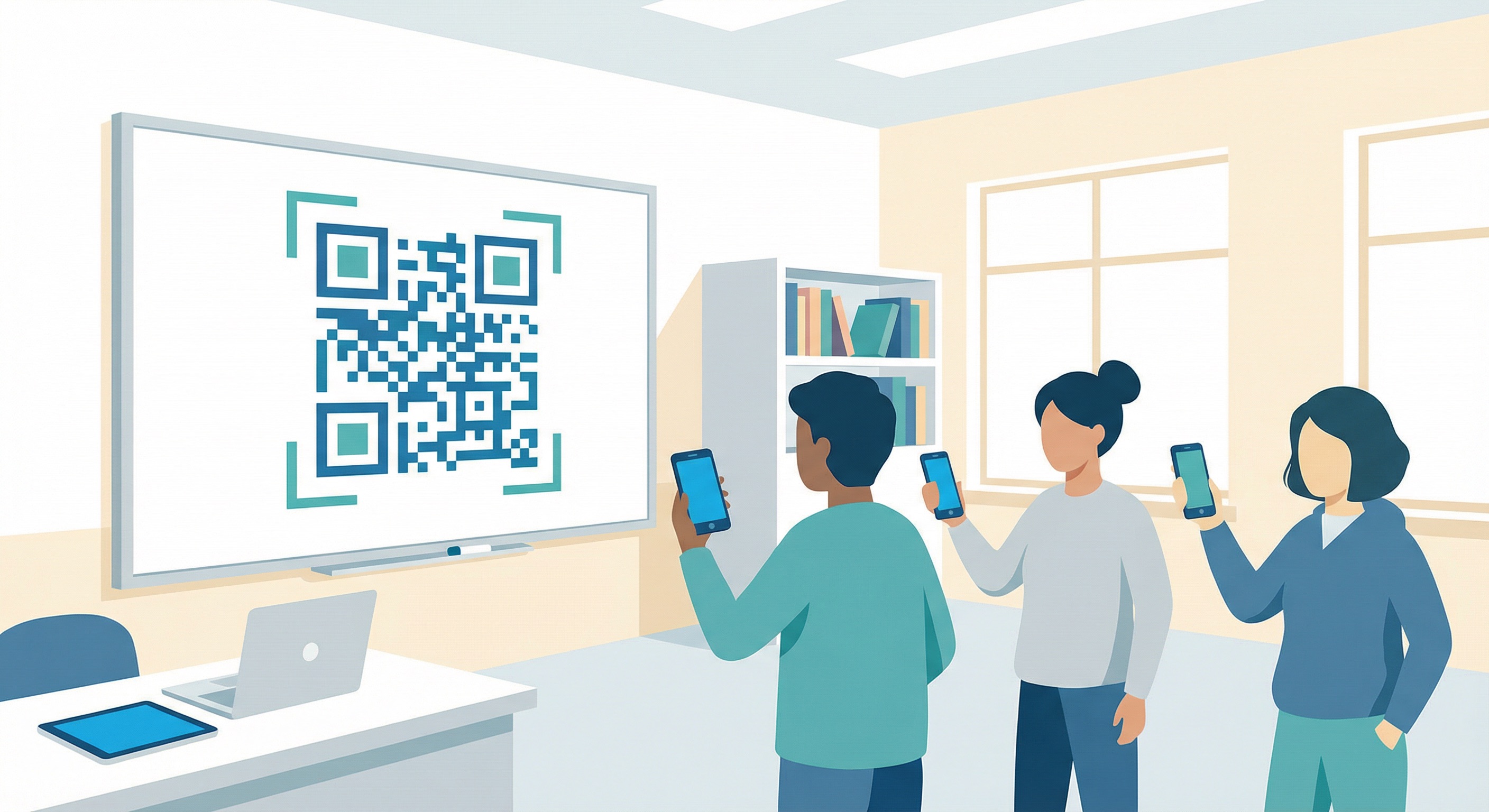

Schools and universities worldwide are racing to close the gap between physical campuses and digital learning. According to EdTech Magazine, 45% of schools and universities in the United States have already adopted QR codes for purposes ranging from accessing digital textbooks to streamlining campus communications. With 2.2 billion people globally now scanning QR codes regularly, the technology has become a natural bridge between printed materials, physical spaces, and the rich digital resources modern education demands. This guide covers every major application of QR codes in education in 2026 — from K-12 classrooms to university campuses — along with the data, best practices, and step-by-step instructions you need to get started.
QR codes deliver measurable advantages for students, educators, and administrators alike. Here is why educational institutions are integrating them at every level.
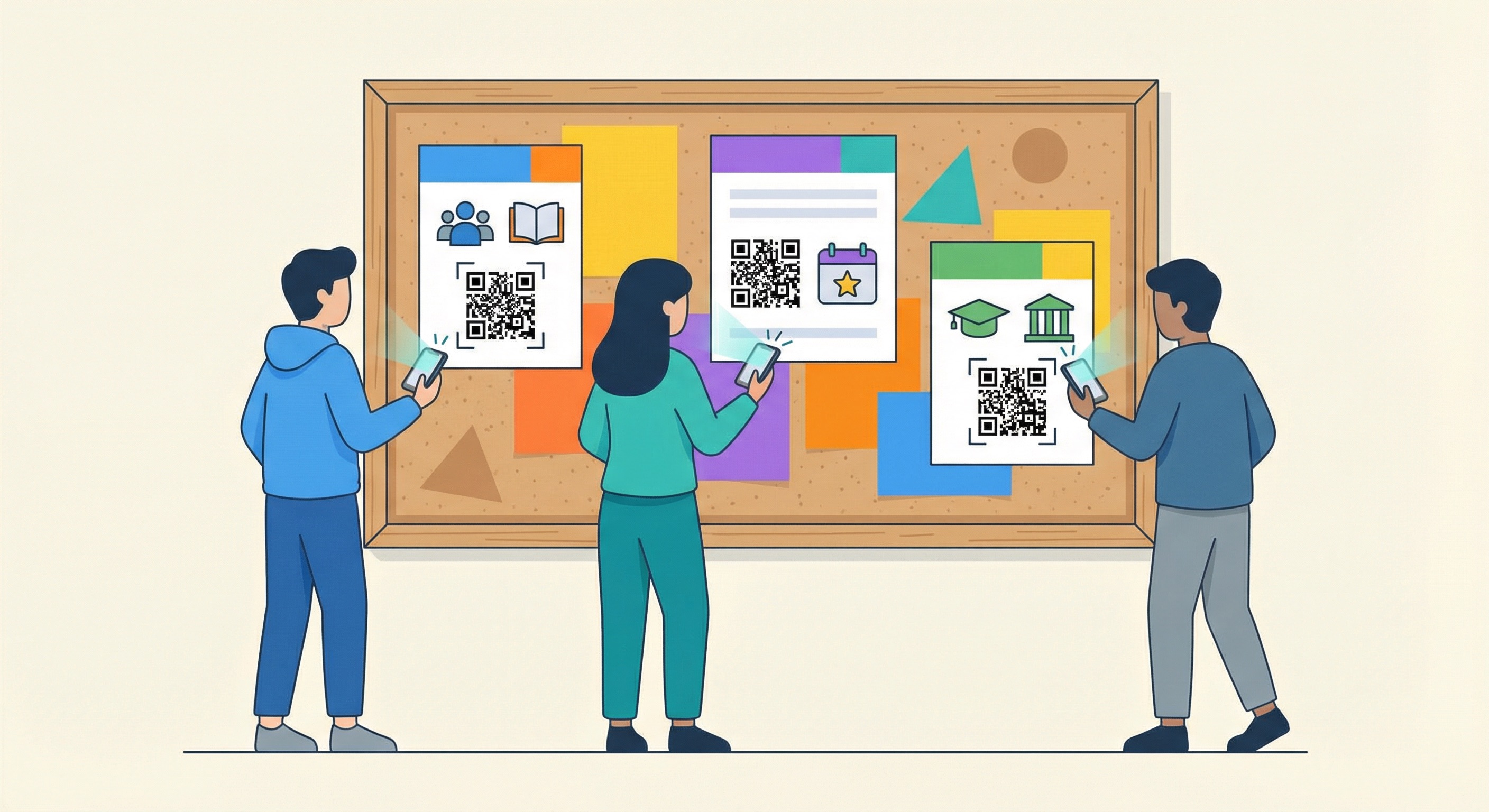
Printed textbooks, posters, and handouts can now carry a dynamic layer of digital content. A QR code printed on a worksheet or displayed on a campus display instantly links students to supplementary videos, interactive quizzes, reading lists, and research repositories — turning static materials into living educational resources without requiring students to type a single URL.
From attendance recording to event sign-ups and feedback collection, QR codes automate processes that once consumed hours of staff time. Research by VerifyEd shows QR code-based attendance tracking takes approximately 7.3 seconds per student and reduces total attendance marking time by over 60% compared to manual methods. That time savings compounds across hundreds of classes and thousands of students every semester.
A 2025 study published in Frontiers in Education found that combining QR codes with cooperative learning strategies produced significant cognitive gains, with an effect size of η² = 0.89 — a large effect indicating that QR-enhanced lessons meaningfully improve knowledge retention compared to traditional instruction. Students in the study reported highly positive attitudes toward QR codes as instructional tools across cognitive, emotional, and behavioural dimensions.
A single URL QR code on a campus poster or brochure can instantly deliver safety alerts, event schedules, club registrations, and term-time updates to tens of thousands of students, faculty, and staff. Dynamic QR codes allow administrators to change the linked destination at any time without reprinting materials — critical for evolving campus information.
QR codes dramatically reduce the volume of printed materials needed across campus. Instead of printing thousands of event flyers, course handouts, and information booklets each term, institutions can print once and update the linked content indefinitely. Clubs, sports teams, and departments save on print costs while campuses generate less waste — a meaningful win for sustainability goals.
QR codes make asynchronous learning seamless. Professors can embed them in slide decks, e-books, and recorded lectures to point students toward additional reading, assignment submission portals, or discussion boards. Students studying remotely access exactly the same enriched materials as those on campus, eliminating the physical-digital divide that can disadvantage distance learners.
From the lecture hall to the library, QR codes have practical applications across every corner of campus life.
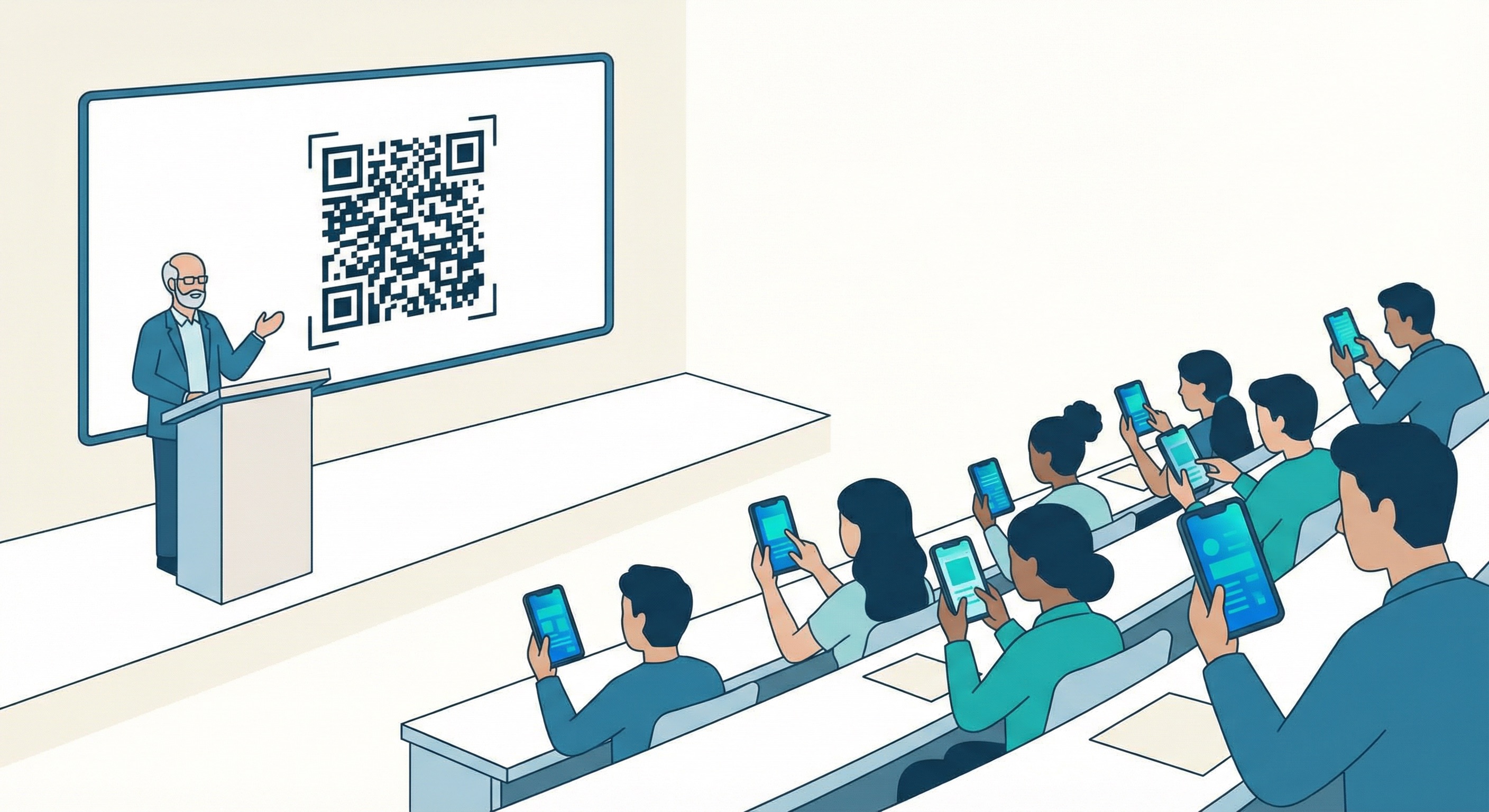
Professors and teachers embed QR codes in textbooks, presentation displays, and printed handouts to link students directly to supporting videos, academic databases, and interactive simulations. Rather than interrupting a lesson to dictate web addresses or hand out multiple sheets, a single scan takes students exactly where the teacher intends. PDF QR codes are particularly popular for distributing reading packs, lab protocols, and assignment briefs without consuming paper.
QR code attendance systems have become a preferred solution in higher education. A unique code displayed at the start of each lecture — which expires after a set window — lets students check in instantly via their smartphones. Modern systems integrate with learning management platforms, generate automated absence alerts, and flag patterns of non-attendance for pastoral support. Compared to paper registers or manual clicker systems, the process is faster, more accurate, and data-rich. Bulk QR codes can be generated for every student in a cohort simultaneously.
Affixing URL QR codes or plain text QR codes to library shelves and books allows students to quickly access catalogue records, subject guides, research journals relevant to that section, and self-checkout information. Some institutions display QR codes at the end of each row to surface the top recommended reads in that subject area — a low-cost discovery tool that encourages deeper exploration of physical collections.
Student and staff ID cards equipped with QR codes provide quick, contactless verification for library access, examination halls, sport facilities, and campus stores. At events, bulk-generated QR codes tied to ticket registrations allow instant scanning at entry points, eliminating queues and reducing the risk of forgery. Scan data gives organisers an accurate headcount in real time. This approach works seamlessly alongside broader event management QR code strategies.
Posters and flyers displayed across campus can carry dynamic QR codes that link directly to event registration pages, online ticketing, or social media profiles. Student unions and clubs use social media QR codes to grow their follower counts rapidly, ensuring students can find their communities with a single scan. Dynamic codes let organisers update linked pages as event details change — without printing new materials.
End-of-module evaluations, post-event surveys, and facilities feedback are dramatically easier to collect via QR codes. Feedback QR codes displayed in lecture theatres, student common rooms, and on campus displays allow anonymous responses in seconds. Institutions gain faster insight into student satisfaction, enabling them to act on feedback within the same academic term rather than waiting for annual surveys.
Research departments use QR codes at conferences and in academic publications to share datasets, supplementary media, or links to the full research paper. Faculty can add QR codes to their vCard or staff profile pages using vCard QR codes, making it easy for students and collaborators to save contact details instantly. Publishing and media departments use them to bridge print and digital outputs across journals, magazines, and promotional booklets.
The following data points underpin the case for QR codes across educational institutions of all sizes.
Creating professional, trackable QR codes for your school or university takes minutes with Supercode's QR code generator. Here is a step-by-step guide:

Select the QR code type that matches your educational use case. The most commonly used types in education include:
Paste the URL, upload the PDF, or enter the text you want students to access. Supercode generates the code instantly. For bulk campaigns — such as creating individual attendance QR codes for every enrolled student — use the bulk QR code feature to upload a CSV and generate hundreds of unique codes in one step. Learn more in our guide on how to create a QR code.
Apply your institution's colours, add the school logo to the centre of the code, and choose a frame with a clear call-to-action message such as "Scan for Today's Resources" or "Submit Your Feedback." Custom-branded QR codes achieve significantly higher scan rates than plain black-and-white codes. Explore Supercode's complete QR code design guide for best practices. Always use dynamic QR codes for signage and printed materials — see our dynamic vs. static QR codes guide to understand the difference.
Supercode's dashboard lets you create folders by department, semester, or use case — keeping every QR code for the Science Faculty, Student Union, or Admissions Office neatly separated and shareable with the relevant team members. This is especially useful for large institutions managing hundreds of active codes across multiple campuses.
Download your QR code in high-resolution PNG, SVG, or PDF format for printing on posters, ID cards, textbook inserts, displays, and brochures. Refer to our QR code printing guide for minimum size requirements and placement recommendations to ensure reliable scanning in every environment.
Every dynamic QR code tracked in Supercode provides real-time scan data: total scans, unique scans, scan locations, devices used, and time-of-day patterns. Educators can see how many students accessed pre-lecture reading materials, which event posters drove the most sign-ups, and how engagement shifts across the academic calendar. Learn how to set up and interpret scan data in our QR code tracking guide.
Campus information changes constantly — lecture room allocations shift, events get rescheduled, and reading lists are updated. Dynamic QR codes allow you to change the linked content at any time without altering the printed code itself. This means a poster that has been laminated and fixed to a campus wall for a year can still direct students to current content. Static QR codes lock in the destination permanently — only use them for fixed, unchanging information like emergency contact numbers. Review our guide to the 15 most practical QR code uses for further application ideas across education and beyond.
A QR code printed too small will fail to scan reliably, frustrating students and reducing engagement. As a rule of thumb, a QR code should be at least 1 inch (2.5 cm) square for close-range scanning, and proportionally larger for materials viewed from a distance — a poster at 1.5 metres needs a code at least 4 cm square. For detailed sizing guidance, see our QR code printing guide. Place codes at eye level on notice boards and in the bottom third of posters to maximise visibility.
Unbranded black-and-white QR codes are ignored. Incorporating your institution's logo, colours, and a clear frame with a call-to-action label ("Scan for Resources," "Scan to Register") signals legitimacy, increases trust, and significantly improves scan rates. Our QR code design guide covers colour contrast, logo sizing, and frame best practices to ensure your codes scan reliably while reflecting institutional identity.
Never display a QR code without contextual instructions. Tell students and faculty exactly what they will get when they scan: "Scan to access today's lecture notes," "Scan to submit your feedback," or "Scan to register for the careers fair." A descriptive label removes hesitation and dramatically increases the likelihood of a scan. This principle applies across all physical placements — from campus posters to digital displays.
Supercode's analytics dashboard reveals which QR codes are performing and which are being ignored. Low scan rates on a poster QR code might indicate poor placement, insufficient sizing, or a design that blends into the background. High scan rates at specific times of day can inform when to update linked content to maximise student engagement. Review analytics at least once per term to continuously improve your QR code strategy. Explore the full QR code marketing guide for optimisation techniques applicable across educational and commercial contexts. See also how healthcare institutions apply similar analytics-driven approaches to improve engagement with their audiences.
Schools and universities use QR codes across academic and administrative functions. Common applications include linking students to digital study materials, textbooks, and PDFs; tracking attendance automatically; enabling contactless entry to examination halls and campus facilities via student ID QR codes; collecting feedback after modules and events; promoting student societies and sports clubs on posters and brochures; and sharing research content and contact information at conferences. Dynamic QR codes are preferred for campus signage because their linked content can be updated without reprinting.
Yes. A 2025 study published in Frontiers in Education found that QR-enhanced cooperative learning produced a large effect size of η² = 0.89 on student cognitive achievement, indicating significant improvements in learning outcomes compared to traditional methods. Students consistently report positive attitudes toward QR codes as instructional tools — they reduce friction in accessing resources, support diverse learning styles, and make interactive activities like quizzes and polls more accessible without requiring additional hardware.
The most useful QR code types for education are: URL QR codes for linking to learning platforms and websites; PDF QR codes for distributing reading materials and assignment briefs; feedback QR codes for collecting module and event evaluations; bulk QR codes for generating individual student attendance or event access codes; and social media QR codes for growing student society followings. For fixed information that does not require internet access, plain text QR codes work reliably.
QR code attendance systems display a time-limited code at the start of each class. Students scan the code using their smartphones, and the system logs their attendance automatically — no paper registers or manual data entry required. This process takes around 7.3 seconds per student and reduces total attendance marking time by over 60%. Advanced systems integrate with learning management platforms, send automated absence alerts, and can include security features such as geolocation verification to prevent proxy attendance.
Absolutely. QR codes are ideal for bridging print and digital content in hybrid and fully remote learning environments. They can be embedded in e-books, digital PDFs, and online presentation slides to link students to supplementary content, assignment portals, or discussion boards. Students studying remotely scan codes from their device screens directly — no separate scanning device is required. Dynamic QR codes ensure that even a printed resource distributed at the start of a semester can link to the most current version of lecture notes, reading lists, or submission deadlines throughout the year.
Static QR codes can be created for free. For the full benefits of education QR codes — dynamic content that can be updated, real-time scan analytics, custom branding with school logos and colours, folder organisation for different departments, and bulk generation for cohort-level campaigns — a Supercode subscription starts at $29 per month. The cost savings from reduced printing, faster administrative processes, and improved student engagement far outweigh the subscription cost for any institution deploying QR codes at scale. Explore all Supercode features or start your free trial today.
QR codes are one of the most cost-effective tools available to educational institutions in 2026. Whether you are a primary school teacher looking to make lessons more interactive, a university administrator streamlining campus communications, or a student union promoting events and clubs, Supercode gives you everything you need: a powerful QR code generator, beautiful design tools, real-time analytics, bulk generation for entire cohorts, and folder organisation for every department. Explore more ways to use QR codes across related sectors — from events and healthcare to the full industry use cases hub. Browse our QR code statistics 2026 for the latest market data, or check our pricing page to find the right plan for your institution. Ready to bring QR codes to your campus? Create your first code free on Supercode.
Head to our FAQs section or reach out to us directly on info@supercode.com
Sign up for free

