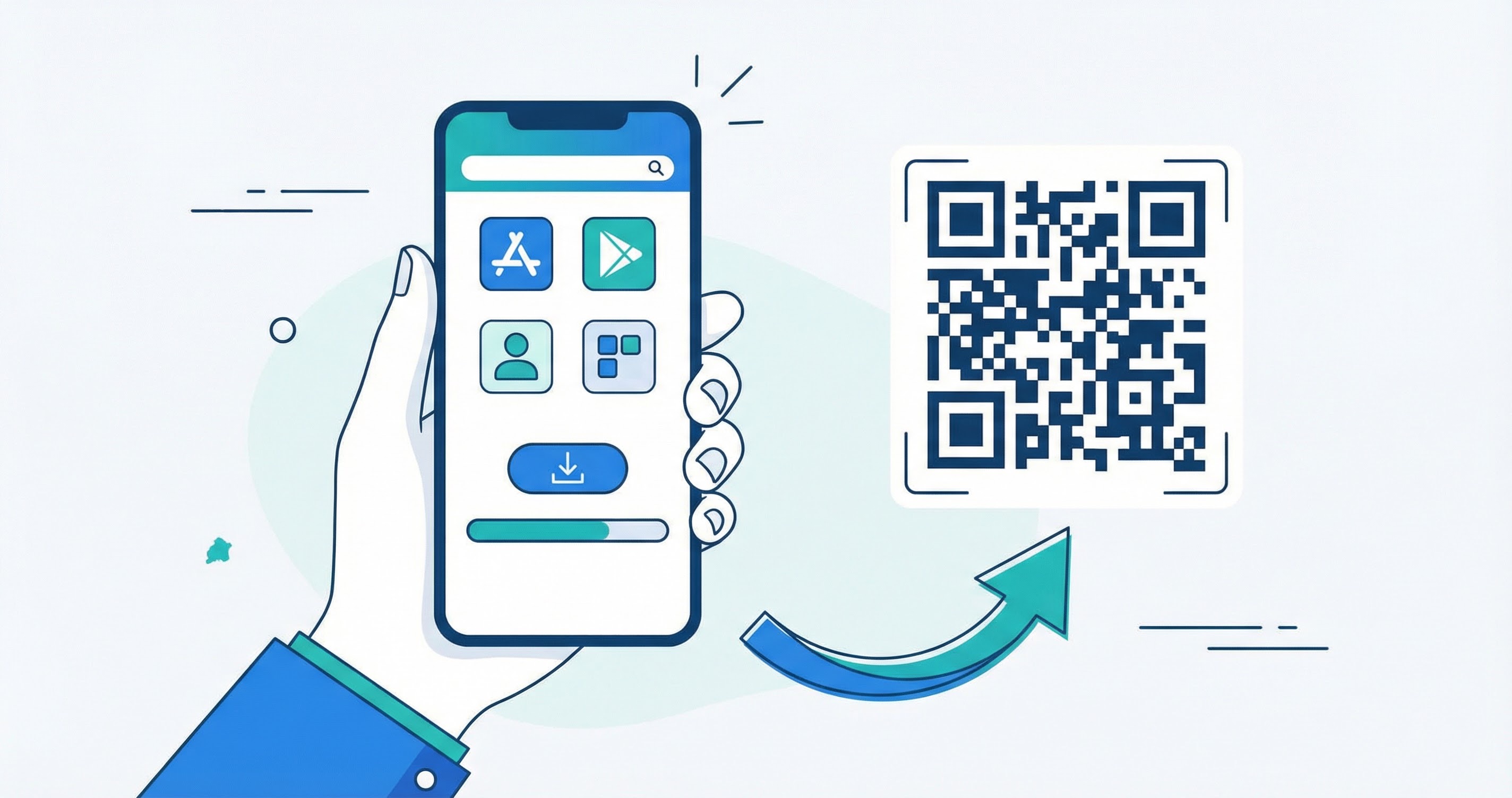
Nearly half of all consumers — 47% — now scan QR codes specifically to download mobile apps. If your app marketing strategy does not yet include QR codes, you are leaving a measurable, high-intent acquisition channel on the table. In 2025, 94% of marketers increased their QR code usage year over year, and QR code campaigns now achieve an average 37% click-through rate — up to four times higher than standard digital ads.
The reason is simple: a QR code for app download removes the friction of searching the App Store or Google Play. One scan takes users directly to your download page, cutting out a step that causes significant drop-off. Whether you are launching a new app or scaling an existing one, QR codes offer a low-cost, measurable path to growth.
This guide covers eight proven strategies for deploying app download QR codes, a step-by-step creation walkthrough using Supercode, design best practices, and a complete guide to tracking campaign performance. Every tactic below is backed by real-world results from brands that have used QR codes to drive meaningful download volume in 2025.

Traditional app marketing relies on users finding your app by searching an app store, following a social media link, or typing a URL. Each of those steps introduces friction — and friction kills conversions. A QR code collapses that entire journey into a single scan.
Here is what makes QR codes uniquely effective for app acquisition:
According to Adjust's 2025 mobile marketing research, nine in ten users now engage with QR codes at least once a week. The infrastructure is in place. The audience is ready. The question is where — and how — to deploy your codes for maximum impact.

Out-of-home (OOH) advertising — billboards, transit posters, bus shelter panels, subway cards — reaches audiences at scale but has historically offered no direct response mechanism. Adding an app download QR code changes that entirely. A passerby who would have seen your billboard and forgotten about it can now scan and be in the App Store within seconds.
QR codes on billboards and street advertisements are most effective when the surrounding creative is minimal and the QR code is large enough to scan from the expected viewing distance. A general rule: a code that is 10 cm wide is readable from roughly 1 metre; scale proportionally for larger placements.
The power of OOH QR campaigns was demonstrated dramatically by Coinbase at the 2022 Super Bowl. Their one-minute TV ad featured nothing but a bouncing QR code — a nod to the classic DVD screensaver. The result: more than 20 million scans, 445,000 sign-ups in the first minute, and a 300% spike in brand interest. The lesson is that a QR code placed in high-traffic, high-attention media can deliver extraordinary volume when the creative context is right.
For your own OOH campaign:
Physical products create a powerful, ongoing touchpoint for app promotion — one that continues working long after purchase. Printing an app download QR code on product packaging catches users at a moment of peak brand engagement: when they are holding your product in their hands.
The fitness technology company Technogym embedded an app store QR code directly on their training equipment. Customers who scan it are taken straight to the Mywellness app, which lets them track workouts, set goals, and sync progress data — turning a purchase into an ongoing digital relationship. This approach works across virtually every product category:
A 2024 consumer survey found that 64% of shoppers have scanned a QR code on a product while in-store, and 61% have done so after purchase. That is a substantial, engaged audience already habituated to scanning packaging codes. Directing them to your app download page is a natural extension of behaviour they are already performing.
For best results, use a high-resolution print at minimum 2 cm x 2 cm, maintain a clear quiet zone around the code, and place it on a flat, high-contrast surface.
Branded merchandise has a unique property that other marketing channels do not: longevity. A QR code printed on a tote bag, coffee mug, or t-shirt can generate scans for months or years after your initial investment. And unlike a digital ad that disappears when the budget runs out, merchandise travels — into offices, homes, and public spaces — reaching audiences who were never targeted in your original campaign.
QR codes on merchandise work particularly well in three contexts:
The key is to give people a reason to scan. Pair the QR code with a tangible benefit: "Scan to unlock exclusive content," "Scan for 20% off your next order," or "Scan to register your product and activate your warranty."

Your website already has your most engaged audience on it. People browsing your product pages, reading your blog, or using your web app are prime candidates for app download — they just need a frictionless path to get there. Adding a QR code to your website bridges the gap between desktop intent and mobile action.
QR codes on websites work most effectively in these placements:
Canva uses this approach effectively: after a user creates their first design on desktop, a popup appears showing a QR code to download the mobile app. The timing is perfect — the user has just experienced value and is most motivated to continue using the product on mobile.
Pair your website QR code with a persuasive CTA. "Scan to get the app — available on iOS and Android" is clear and actionable. You can also offer an incentive exclusive to app users, such as additional storage, premium features for 30 days, or early access to new features.
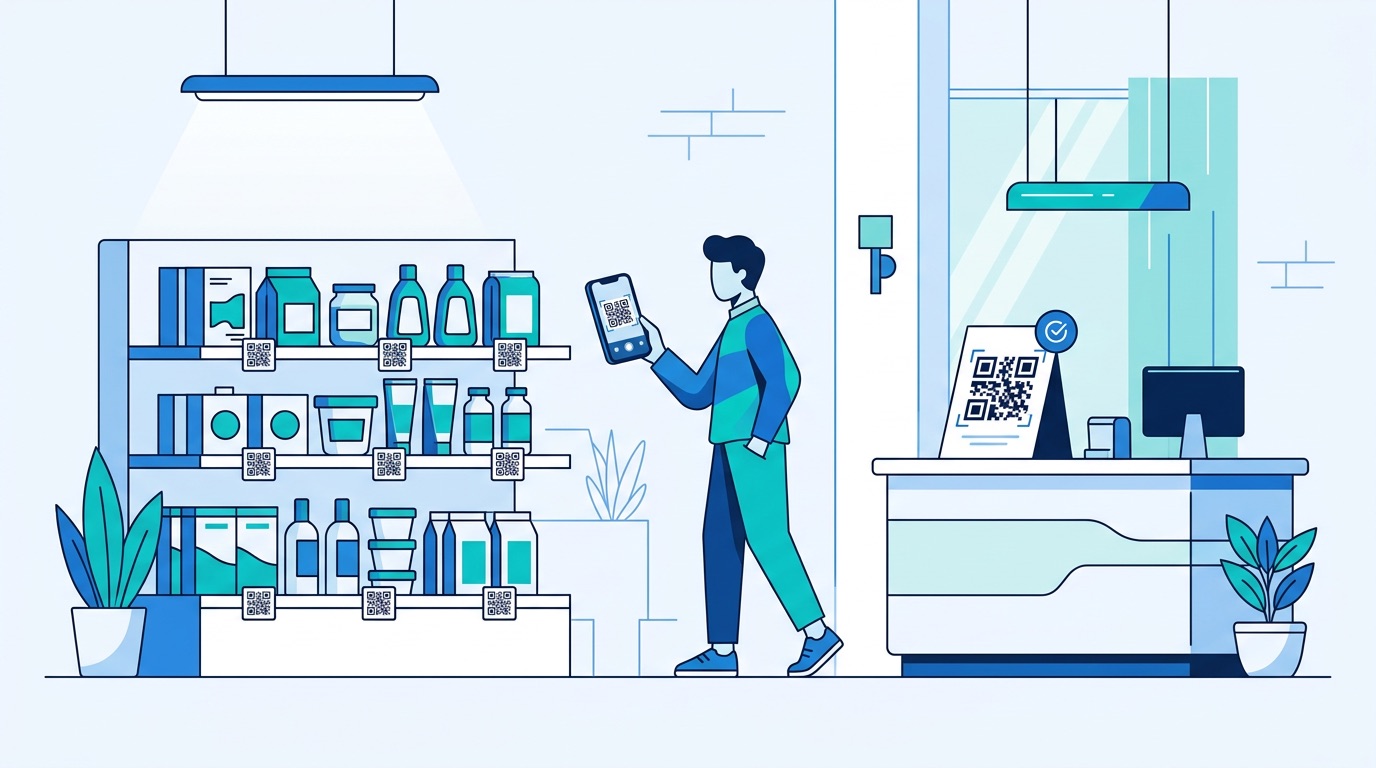
Physical retail locations offer some of the richest opportunities for app download QR codes. Customers in your store are already engaged with your brand — an app download QR code catches them at a moment of active interest and gives them a way to deepen that relationship beyond the immediate visit.
QR codes for shop windows are particularly powerful because they work when the store is closed. A customer walking past at 9pm who cannot enter can still scan the window code to download your app and browse your inventory, make a reservation, or place an order for collection. For retail businesses, this effectively turns your storefront into a 24/7 conversion tool.
Inside the store, consider these placements:
For gyms and fitness businesses, placing QR codes next to equipment — linking to a companion fitness tracking app — creates a usage loop that strengthens retention as well as acquisition.
Email is the most common channel where marketers now incorporate QR codes, used by 47% of marketing teams according to Bitly's 2025 survey. The logic is straightforward: email reaches a warm, opted-in audience that already has a relationship with your brand. A QR code in an email gives that audience a one-tap path to your app.
The most effective use cases for app QR codes in email campaigns:
Beyond email, consider adding app download QR codes to digital display banners (especially retargeting ads where the user is already familiar with your brand), LinkedIn company updates, and any digital PDF or brochure you distribute. A QR code on a digital document can be scanned directly from a secondary device — laptop users frequently scan with their phones.
Print marketing collateral presents a consistent, high-value opportunity for app download promotion. QR code brochures and flyers give readers an immediate action to take — one that moves them from passive information consumption to active engagement with your digital product.
Consider these print placements:
Print QR codes require careful attention to minimum size and print quality. Review our complete QR code printing guide to ensure your codes scan reliably across different paper stocks, print methods, and lighting conditions.

Trade shows and industry events concentrate large numbers of engaged, relevant prospects in one place. For app-first businesses, this is a prime opportunity to drive bulk downloads from a highly qualified audience. QR codes for trade shows are now a standard part of the exhibitor toolkit, but the difference between a high-converting deployment and a low one is in the execution.
Strategies that consistently drive downloads at events:
For event management businesses, QR codes serve a dual purpose: you can use them to manage check-in and ticketing while also promoting a companion app for attendees.
Creating a professional, branded app download QR code takes less than five minutes with Supercode's QR code generator. Here is the exact process:
If you are running a multi-channel campaign, consider creating separate dynamic codes for each channel (packaging, email, in-store, OOH) and using Supercode's folder system to organise them. This lets you compare performance across placements in a single analytics dashboard. View Supercode's pricing — every feature on every plan, choose the scan volume for your campaign scale.
A QR code that matches your brand identity is not just aesthetically superior — it performs better. Research consistently shows that branded QR codes with logos achieve significantly higher scan rates than generic black-and-white codes, because they communicate authenticity and signal to the user exactly what they are about to interact with. Here are the key design principles for app download codes:
For a comprehensive walkthrough of QR code design options, colour psychology, and logo integration, read our QR code design guide.

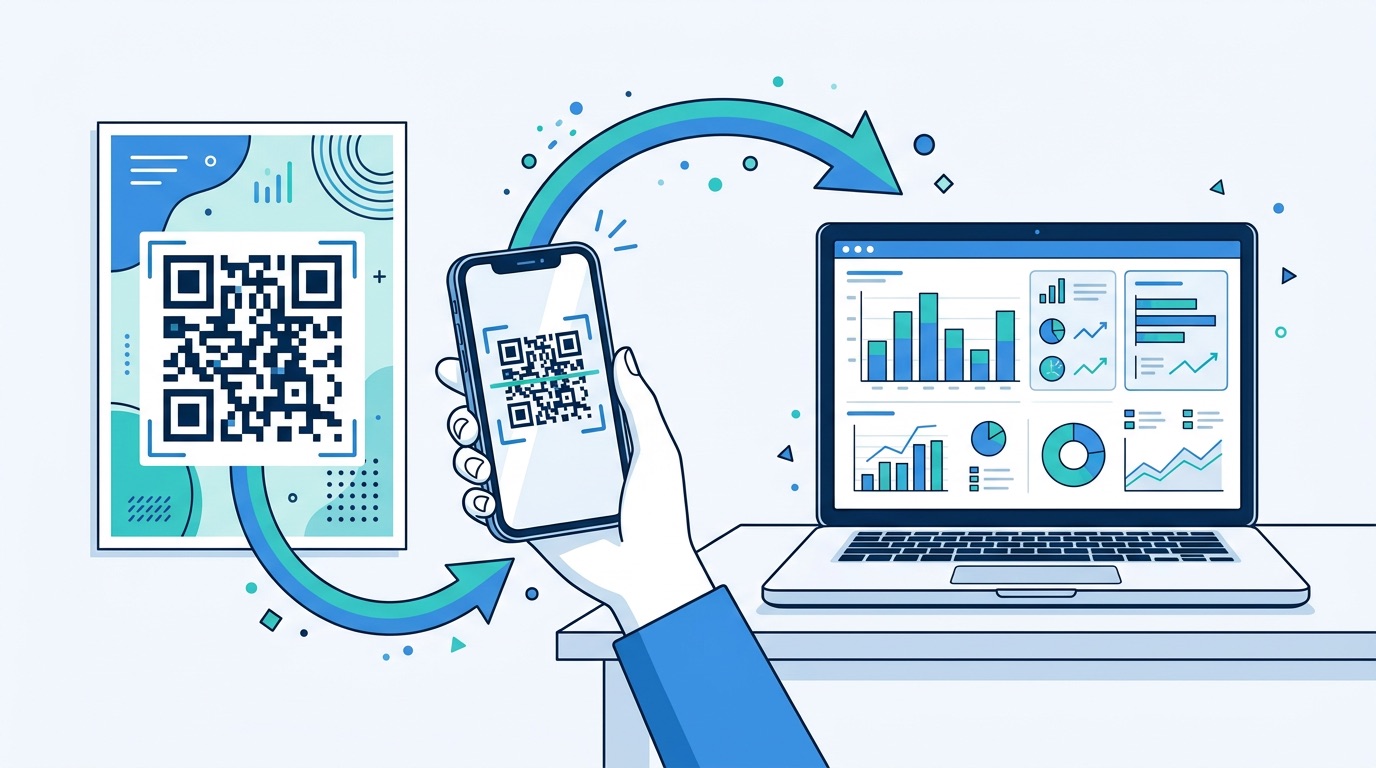
Tracking is what separates a QR code campaign from a QR code experiment. Without analytics, you do not know which placements drive the most scans, which designs convert best, or whether your campaign is delivering a return on investment. With tracking, every decision is data-driven.
Supercode's QR code analytics dashboard provides real-time data on every dynamic code you deploy. Key metrics include:
According to Bitly's 2025 research, 69% of marketers update or redirect their dynamic QR codes at least monthly based on performance data. This is the right cadence for a living campaign — use your analytics to identify underperforming placements, update destinations for seasonal promotions, and A/B test different call-to-action messages without reprinting a single code.
For deeper campaign attribution — connecting QR scans to in-app events, revenue, and retention — integrate Supercode's dynamic codes with a mobile measurement partner (MMP) such as Adjust or Appsflyer. This closes the loop between a physical scan and a measurable app outcome, giving you the full-funnel view needed to justify and scale your QR code investment. Our QR code statistics for 2026 provide useful benchmarks for evaluating your campaign performance.
Yes. Using a dynamic QR code with a smart redirect, a single code can detect the user's operating system and automatically route iPhone users to the Apple App Store and Android users to Google Play. This is the recommended approach for most campaigns as it simplifies your materials and avoids confusion. Supercode's URL QR codes support smart redirects, and you can set up separate destination URLs for iOS and Android within one dynamic code.
Supercode offers a free plan that allows you to create and download QR codes. However, for app download campaigns we strongly recommend using dynamic codes, which are included on every Supercode plan including the free plan. Dynamic codes allow you to update the destination URL after printing, track scan analytics (total scans, unique scans, device type, location), and run multiple campaigns simultaneously. View Supercode's pricing plans to compare tiers — every plan includes all features — start free and upgrade only when you need more scan volume.
The minimum recommended size is 2 cm x 2 cm (approximately 0.8 inches square) for close-range scanning. For outdoor placements or contexts where users will be scanning from a distance, scale proportionally: a code needs to be approximately 1 cm wide for every 10 cm of scanning distance. A billboard code readable from 5 metres should therefore be at least 50 cm wide. Our QR code printing guide covers size, resolution, and DPI requirements in full detail.
Create a separate dynamic QR code for each placement in Supercode, and append unique UTM parameters to each destination URL (e.g., ?utm_source=billboard&utm_campaign=app-download-2026). This gives you two layers of tracking: scan data from Supercode's analytics dashboard and downstream conversion data from your mobile analytics platform or MMP. Compare scan-to-install rates across placements to determine where to concentrate your spend.
Dynamic QR codes created with Supercode remain active for as long as your subscription is active. Static codes are permanent and never expire, but they cannot be updated or tracked. For app campaigns — where you may want to update the destination, redirect users to a seasonal promotion, or swap an App Store link for a web fallback — dynamic codes are the clear choice. If you cancel your subscription, dynamic codes will stop redirecting, so plan your campaign lifecycle accordingly.
Yes. Supercode's design editor lets you set custom foreground and background colours, add your logo or app icon to the centre of the code, choose from multiple frame styles with custom CTA text, and select from different module shapes. Branded QR codes consistently outperform plain ones for scan rate, and Supercode applies 30% error correction by default so logos do not compromise scanability. Read our QR code design guide for step-by-step instructions.
QR codes are one of the most cost-effective channels available for mobile app acquisition. They work across every medium — print, OOH, packaging, merchandise, email, and in-store — and deliver measurable, attributable results. With 94% of marketers increasing QR code usage in 2025 and consumer scan rates at all-time highs, the window to build a competitive advantage through QR code marketing is wide open.
Supercode gives you everything you need to create, customise, deploy, and track professional app download QR codes. Explore our full range of QR code solutions or sign up and launch your first code in minutes.
Sign up free on Supercode and create your first app download QR code today.