Over 75% of consumers now prioritize sustainability when making purchasing decisions — and 65% actively seek out environmentally responsible brands, according to recent market research. Yet many businesses still pour budgets into printed flyers, brochures, and cardstock handouts that end up in landfill within days. QR codes offer a smarter path: replace mountains of paper with a single scannable code that delivers richer content, real-time analytics, and a measurable positive impact on your environmental footprint.
This guide covers everything you need to know about QR codes for sustainable marketing in 2026 — from eliminating print waste and building eco-friendly packaging to EU Digital Product Passport compliance and measuring your green ROI.
Sustainable marketing is the practice of promoting products and services in ways that minimize environmental and social harm while still achieving business growth. It goes beyond simply calling a product "eco-friendly" — it encompasses the entire marketing supply chain, from how you communicate with customers to what physical materials you produce in doing so.
In 2026, sustainable marketing has become a board-level business imperative rather than a niche concern. Three trends are driving this shift:
The challenge is translating green ambitions into green actions across every customer touchpoint. That's where QR code marketing becomes indispensable.
QR codes bridge the gap between sustainable intent and sustainable execution. They replace physical marketing collateral — brochures, flyers, menus, instruction sheets, business cards, event programmes — with a scannable square that delivers unlimited digital content on demand.
The results speak for themselves. 88% of marketers reported more positive consumer sentiment toward QR codes in 2025, with 40% noting this shift was substantial. Meanwhile, 79% of consumers said they are more likely to purchase products that use QR codes to provide additional product information. This isn't just convenience — it's consumers rewarding brands that invest in smarter, more sustainable communication.
From a sustainability standpoint, a single dynamic QR code can replace thousands of printed assets:
Supercode's QR code generator lets you create dynamic codes that update content without reprinting — meaning your printed QR code never becomes obsolete, and you never need to order a new print run just because a URL or promotion changed.
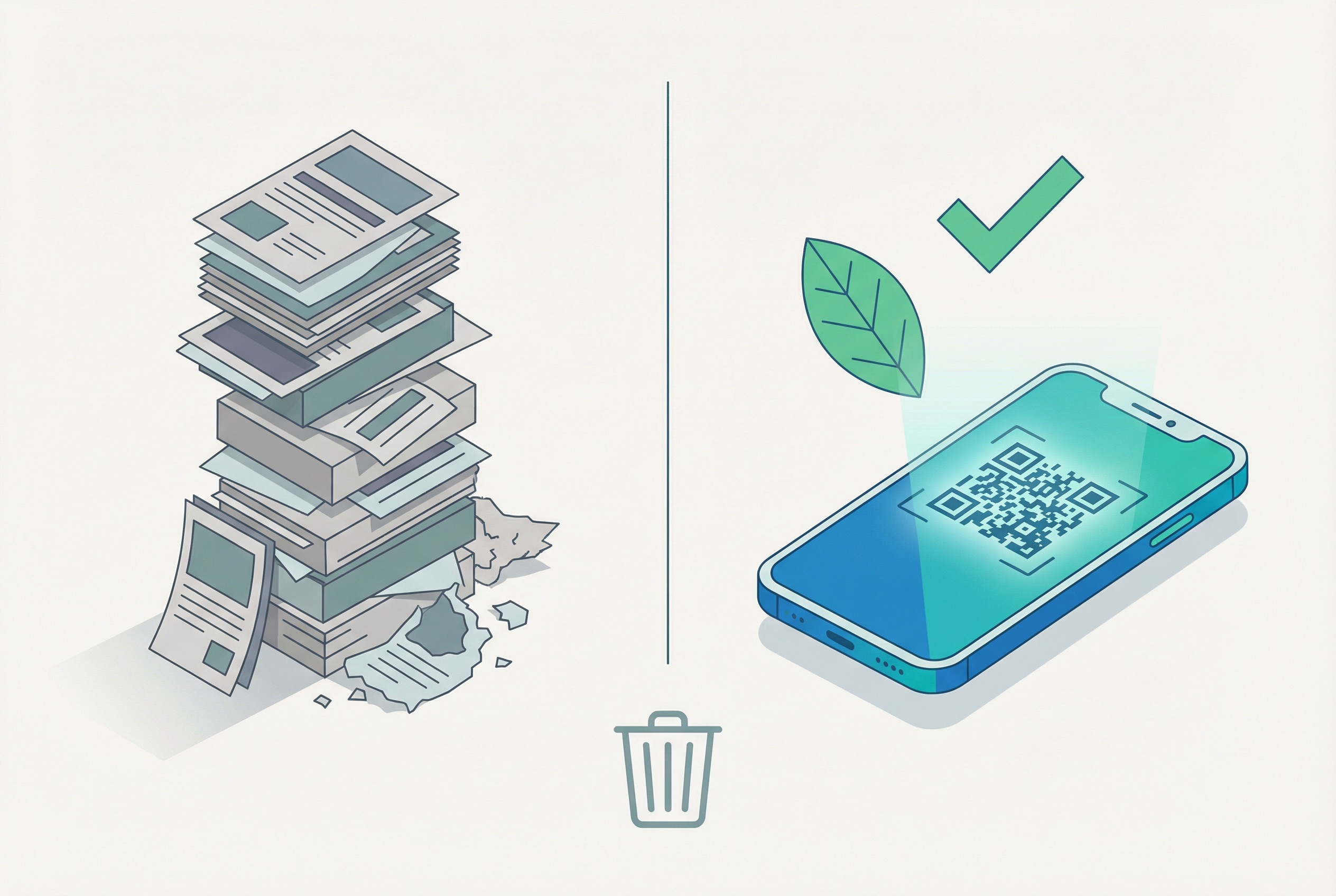
The environmental cost of traditional print marketing is staggering. Consider the numbers:
Now translate that to a typical marketing campaign. A mid-size company running seasonal promotions, product launches, and trade show appearances might print hundreds of thousands of pages annually. Each item has a short active life — a flyer is glanced at for seconds before being discarded.
QR codes change the equation entirely. A PDF QR code delivers a full product catalogue directly to a customer's smartphone — no printing, no postage, no waste. A QR code on a poster or billboard keeps driving engagement for months without generating a single additional page of print. And when your offer changes, you update the destination URL in your dashboard — not on the printer.
For brands that still need some printed collateral, QR codes on brochures and print materials dramatically reduce the volume needed. Instead of a 24-page product catalogue, a single-sided flyer with a QR code delivers the same information digitally — cutting print volume by up to 95%.

Product packaging is one of the most powerful canvases for sustainable marketing — and QR codes are transforming what packaging can communicate without adding a single gram of extra material.
The smart labels market — which includes QR codes, NFC, and RFID — is valued at $25.81 billion in 2026 and projected to reach $60.41 billion by 2035, driven largely by sustainability and traceability demands. The interactive QR packaging market specifically was valued at $5.2 billion in 2024 and is forecast to nearly double to $9.8 billion by 2034.
What can a QR code on packaging deliver? Far more than any printed label has room for:
For food brands, QR codes on food packaging enable ingredient transparency that resonates strongly with health-conscious and sustainability-minded shoppers. For FMCG and retail brands, QR codes on product packaging replace thick paper inserts with a scannable gateway to the same information — and then some.
Modern consumers don't just want sustainable products — they want proof. A 2024 consumer survey found that 39% of respondents said they would use QR codes to access sustainability information if it were made available on products. This appetite for transparency extends beyond the product itself into the supply chain behind it.
QR codes make end-to-end traceability practical at scale. Each unit in a production run can carry a unique QR code — generated in bulk via Supercode's bulk QR code generator — linking to a digital record of that item's journey. From raw material origin to manufacturing facility, logistics route to retail shelf, the full story is accessible with one scan.
This matters most in three sectors:
According to QR code adoption data, brands using QR codes for supply chain transparency report higher consumer trust scores and reduced rates of product returns and disputes. The 2026 QR code statistics confirm this trend: transparency-driven scans are among the fastest-growing QR code use cases globally.

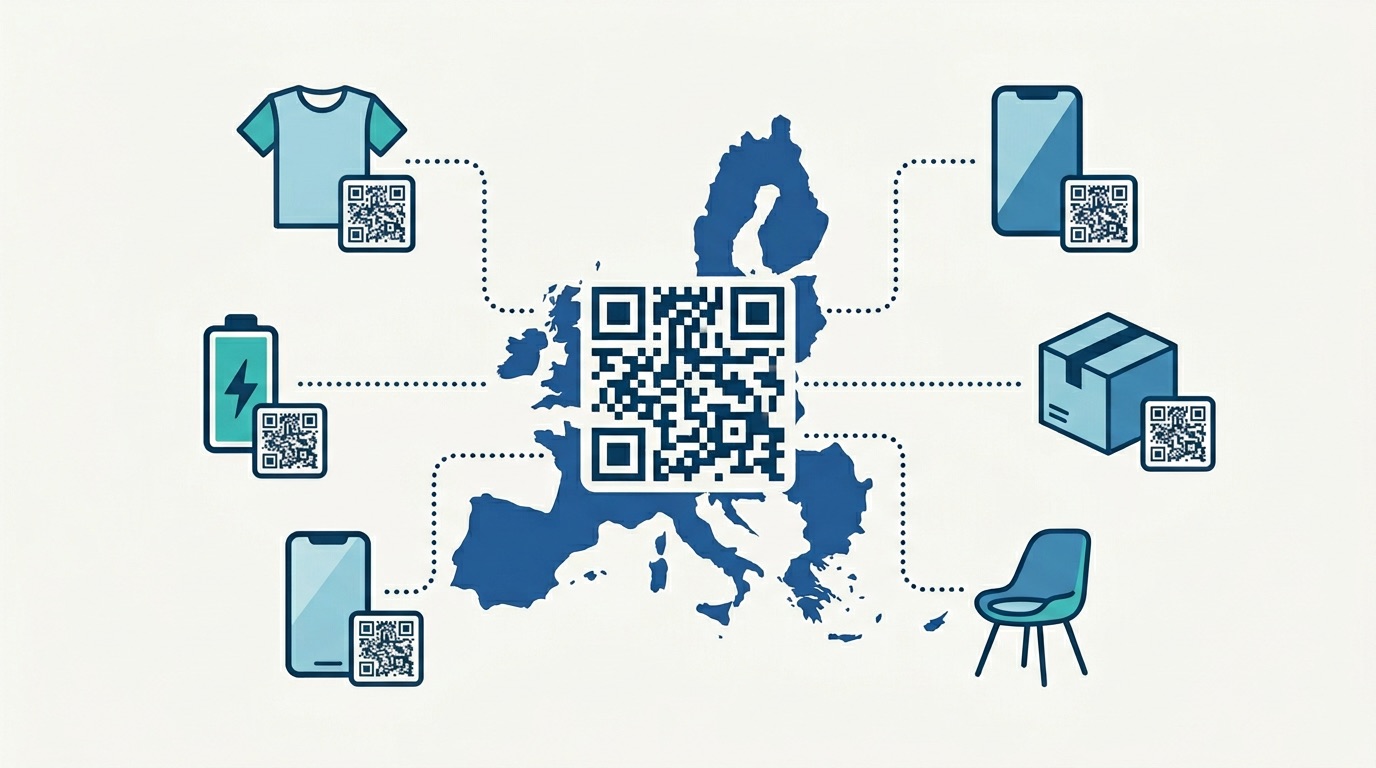
If your business sells physical products in the European Union, the EU Digital Product Passport (DPP) is not optional — it's a compliance requirement with significant financial consequences for non-compliance.
The DPP is the EU's mechanism for enforcing product sustainability transparency across the entire supply chain. It requires brands to provide digital records — accessible via QR code — containing details on a product's materials, carbon footprint, repairability, and recycling pathway. The regulation is being phased in starting 2026, with textiles and batteries first, followed by electronics, furniture, construction materials, and over 30 other product categories by 2030.
Key facts about the EU DPP that every marketer and product team should know:
Supercode's dynamic QR codes are built for exactly this kind of long-lived use case. You create the code once, print or label it, and update the linked destination as regulations or product data evolves — without ever reprinting. Learn more about Supercode's QR code platform and how it supports enterprise-scale compliance needs.
For deeper context on how regulation is reshaping QR code adoption, the QR code trends for 2026 article covers the regulatory landscape in detail.

Events and trade shows are traditionally among the most wasteful marketing environments. Exhibitors ship tonnes of printed brochures, catalogues, and giveaway materials to venues — most of which are left on tables or thrown away by attendees before they reach the exit.
QR codes eliminate this waste almost entirely. A well-designed QR code strategy for trade shows replaces:
For event management, the benefits extend beyond sustainability. Digital registration via QR reduces queue times, eliminates data entry errors, and gives organisers real-time attendance data. Post-event, follow-up content can be delivered via the same QR codes — keeping the conversation going without printing anything new.
One hospitality brand reduced their trade show print spend by 78% in a single year by switching to QR-first event collateral — while simultaneously increasing lead capture rates because digital form submissions were 3x more likely to be completed than paper cards.

One of the most powerful arguments for QR codes in sustainable marketing is the ability to prove your environmental impact — not just claim it. Traditional print campaigns offer no feedback mechanism: you spend money, distribute materials, and hope for the best. QR codes change this fundamentally.
Supercode's QR code analytics provide real-time scan data including:
For sustainable marketing specifically, this data lets you build a compelling environmental case. If a QR code on a poster receives 4,000 scans, that's 4,000 interactions that would have required physical handouts in a traditional campaign — representing thousands of sheets of paper, kilograms of ink, and hours of distribution labour saved. This is real, measurable impact you can report to stakeholders and include in ESG disclosures.
Dynamic QR codes add another sustainability dimension. Because you can update the destination URL without reprinting the physical code, you never need to discard and replace printed materials when campaigns evolve. According to Business Wire, the ability to update content without reprinting is now cited as one of the top three reasons marketers choose dynamic over static codes.
For enterprises managing hundreds of simultaneous campaigns, Supercode's analytics dashboard — included on every Supercode plan, including the free plan — provides campaign-level rollups that let sustainability teams quantify total paper-equivalent savings across the organisation.
See how QR code analytics compares to traditional measurement in our guide to QR code tracking and analytics, and explore the market data behind these trends in our 2026 QR code statistics report.
Ready to make QR codes the engine of your eco-friendly marketing programme? Here's a practical framework for getting started:
Before you can reduce print waste, you need to know where it comes from. Catalogue every type of printed marketing material your business produces annually — flyers, brochures, catalogues, event materials, packaging inserts, business cards. Note the volume, cost, and estimated lifespan of each.
Not all print is equal. Start with the items that have the shortest lifespan and highest volume: event handouts, seasonal flyers, and disposable packaging inserts. These are your quickest sustainability wins with the clearest ROI.
Always use dynamic QR codes rather than static ones for sustainability-focused campaigns. Dynamic codes let you update the destination without reprinting the physical code — the cornerstone of a sustainable QR strategy. Static codes, once printed, are permanently locked to a URL, meaning any change requires a new print run.
A QR code that doesn't get scanned doesn't achieve anything. Use Supercode's custom QR code design tools to create codes that incorporate your brand colours and logo while maintaining scan reliability. Include a clear call-to-action near every code: "Scan to learn more," "Scan for the full catalogue," or "Scan for recycling info."
Think about where your audience will naturally have their phone in hand. Product packaging is scanned at point of purchase and at home. Posters work best in locations where people pause — near entrances, waiting areas, or checkout points. Displays and point-of-sale units benefit from QR codes that provide instant additional product context.
For campaigns spanning multiple products, locations, or SKUs, bulk QR code generation via CSV upload saves hours of manual work and ensures consistent quality across every code in the campaign.
Set up a sustainability reporting cadence. Monthly or quarterly, pull your QR analytics, calculate the print-equivalent interactions, and report the environmental savings to your marketing and ESG teams. Over time, these numbers become a powerful part of your brand's sustainability story.
Start building your sustainable QR code strategy today — try Supercode free and create your first dynamic QR code in under two minutes. No credit card required.
QR codes replace physical printed marketing materials — flyers, brochures, catalogues, business cards, instruction inserts — with a single scannable code that delivers the same (or richer) content digitally. This reduces paper consumption, ink usage, printing energy, and distribution logistics. A dynamic QR code can be updated indefinitely without reprinting, making it a permanently reusable communication channel.
The EU Digital Product Passport (DPP) is a regulatory requirement that mandates brands provide digital records of a product's materials, carbon footprint, and recycling pathway — accessible via QR code or similar technology. Rolling out from 2026 across textiles, batteries, electronics, and other categories, the DPP makes QR-code-enabled product transparency a legal compliance issue, not just a marketing choice. Non-compliant brands face fines of up to €100,000 per product and EU market exclusion.
Yes. Dynamic QR codes are significantly more sustainable because they can be updated — the URL destination can change without reprinting the physical code. If your promotion ends, your product changes, or your sustainability data is updated, you simply change what the code links to in your dashboard. Static QR codes, once printed, are permanently locked to a URL, meaning any change requires a new print run and discarding the old materials.
Supercode's analytics dashboard shows you total scan volume for every QR code. Each scan represents a customer interaction that, in a traditional campaign, would have required a physical handout. By tracking scans over time and comparing them to your previous print volumes, you can calculate paper saved, CO₂ avoided, and cost savings — data that feeds directly into ESG reporting and sustainability disclosures.
Yes. A vCard QR code stores your full contact details — name, title, phone, email, website, LinkedIn — and transfers them directly to a contact's phone when scanned. Unlike a printed business card, it never runs out, never becomes outdated when your details change, and doesn't end up in a drawer or recycling bin. Businesses switching to vCard QR codes typically save hundreds of pounds per person per year in reprinting costs alone.
Any industry that currently relies on high-volume printed marketing materials stands to gain significantly. The clearest wins come in retail, food and beverage, hospitality, events, fashion, and pharmaceuticals — all sectors with high print volumes and strong consumer demand for sustainability transparency. The EU Digital Product Passport regulation makes QR code adoption mandatory for many product categories across virtually all industries selling into European markets.